Visiting When She’s Entranced – 10 May 2017 –

I had a good “new normal” visit with Leslie today. She was seated at her lunch table, awake and lightly smiling when I arrived around 11:30. rolled her into the activity room for some arm stretches, and we did those reasonably well, then we rolled back to the dining room for lunch. She started slow, but ate okay overall—after which we rolled away, this time out to the deck. It wasn’t chilly, but a little breezy, so I laid my blue/black flannel shirt on her for warmth.

Once again, as I started massaging and twisting her ankles, she closed her eyes and seemed to nod off, but not into a deep sleep. She stayed in that state, with a slight but noticeable smile, during the whole time I worked on her ankles and knees and stretched her legs.

Leslie’s role in all these leg stretching was passive, as it always is, and I wondered if she could do the “push back” exercises we do while she was nodded off. Apparently she could, because she did, and got into it pretty quickly.

The way this works is that I lift her leg up a bit, take her foot in my hands and push towards her chest, directing my force towards bending her leg at the knee and pushing the knee up into her chest. I’m usually able to cajole her into pushing back with enough force to keep her knee from bending, even when I push pretty hard, but sometimes it takes a few tries for her to get her leg movement organized and working for her.

It’s easy for me to tell when she’s pushing and when she’s not, because when she’s not, her knee bends easily and I can push it right up into her chest. This time, her knee started to bend with my first push, but I felt a little resistance from her about half-way through and told her so,

“Okay, Leslie, good for you. You got into this quickly today! That’s one. And now this is two!” I said as I pushed again. In response to my second push, she pushed back more quickly, but not immediately–which suggests her pushing was deliberate, and not an instinctual response.   “Great!” I said. “You’ve got it going for you today.” Then “Three!  Good. Way to go!   Four! Wow, even better. You’re pushing back hard and I’m getting nowhere. Five! Great!  Six!” and so on, up to ten.

I complimented her on doing a great job with her left leg and told her we’d now be switching to the right.

“Okay, Leslie. Here we go with your other leg. One!” I said, pushing her leg towards her, this time with the sole of her right shoe in my hands. Her resistance came even quicker with her right leg than the left. “Great! Good for you, Leslie. Now, two! Good once again. You’re pushing back right away and pushing hard. Three!”  And so on, up to ten.

All of this back and forth pushing took place while Leslie was still adrift in some form of sleep or trance. Her eyes never opened and her face held the same, somewhat relaxed and slightly smiling expression through all twenty repetitions. She didn’t say anything, nor did she make any noticeable gestures, and nothing else about her indicated she understood and was responding to my words—except that she would actively push back, firmly and strongly, when I tried to push her legs into her chest. That was evidence enough for me to imagine she heard what I was saying and so I kept talking to her while we completed the exercise set.

After the leg pushes, Leslie and I were done with our usual exercise routine, her eyes were shut and she looked like she was still dozing. I thought of just rolling her chair back inside and leaving, but the previous week I’d managed to get her more comfortable in her chair while she was asleep. She wasn’t as twisted today as she’d been then, but she was still slumped forward on an angle, her hand locked between her knees and her head tipped to one side. Why not just work on her head and neck for a while and see what I could do?

I started by reclining her wheel chair a little farther back, then rubbing her neck and head, pressing backwards as I did. Her neck was pretty tight, particularly the muscles that run from the back of the skull towards the collar bone. To get her to lay it all the way back to where it was resting on the chair back, I would need to push and hold very forcefully—and risk harming her—or relax the muscles she was tensing to keep her head tipped forward.

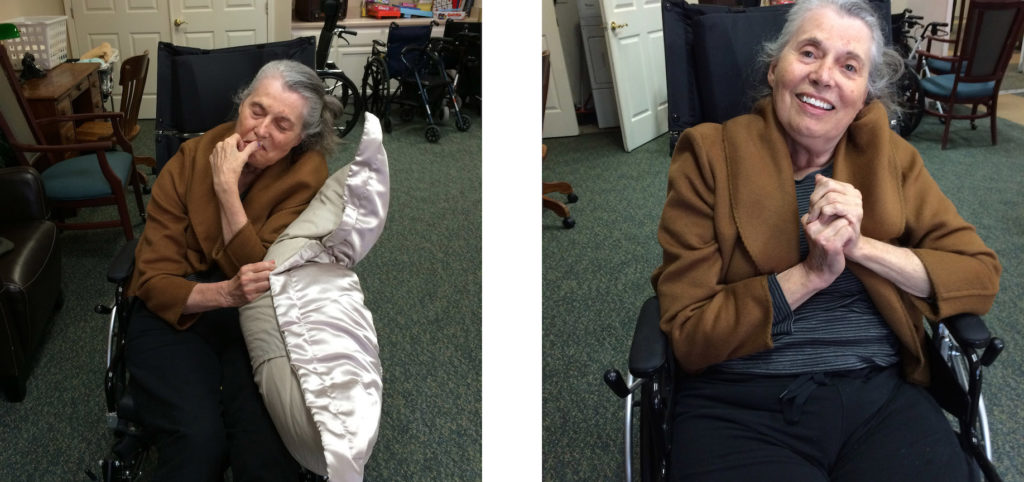
It took about ten minutes of massaging her head and neck muscles to get there, but eventually her head was resting on the chair back, and she looked really relaxed. Seeing her that relaxed was unusual, and actually a little disturbing. I took a photo to document her position and pose, and when I viewed the photo, it gave me a start. Outside of the context of our quiet and animated exercising, there was little about her to indicate that she was still alive.
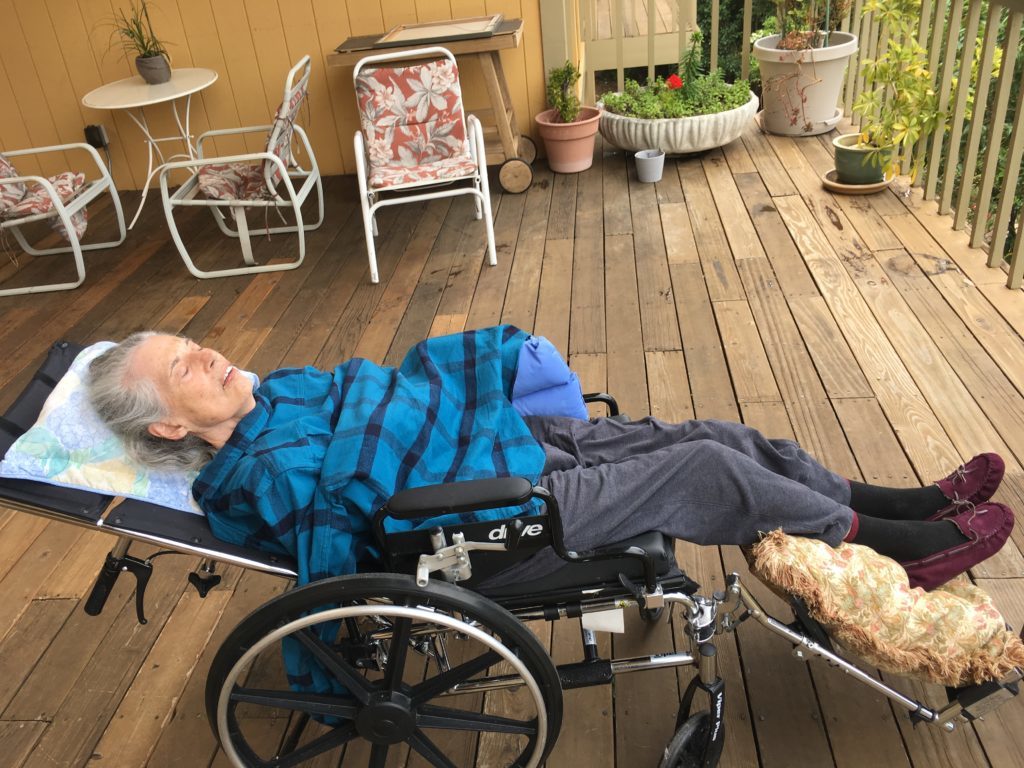
I adjusted Leslie’s chair so it was more upright and told her that we were pretty much done. I then moved my chair from her feet to the side of her wheelchair, and as I did, she gave a little sigh, stretched her arms out a bit, and opened her eyes. I sat down next to her, our chairs facing in opposite directions so I could see her face.

“Welcome back!” I said. “You’re here now, and I’m here. We’re both here!” She smiled very broadly at that and reached for my hand. I gave it to her and we sat there together for another ten minutes or so, holding hands, I told her that she did a great job with the leg pushes today, then added, “I think you probably heard everything I said while we were doing those. I wasn’t sure, but I kept talking anyway, just in case.”

It was just after that when I decided to tell Leslie what I’d recently been thinking about and mentioned to Lisa the night before: the idea that maybe our life-long connection was affirmed, at least in part, by looks of mutual recognition. The way I put that to Leslie went something like this:

“I’ve recently been wondering if, when we were children, we were both living in worlds where the people around us could not really see us for who we were–and maybe not see each other for who they were either. That seems a lot like how my family was for me, and maybe it’s how yours was for you as well. Well, what if the two of us could somehow do with each other—or at lest pretend to do–what we couldn’t do in our families? And what if we could do that with each other at the same time? That would have been pretty special, I think, and memorable!

“I’m telling you this because from as far back as I can remember weeing you, I can remember sharing what I thought were looks of deep, mutual recognition, and those shared looks stood out from my interactions with other people. They might have be brief, but I felt them deeply, with a kind of click or clunk of connection. It was like an elemental recognition of some sort had been toggled to “on” from its usually off position, and I knew there was someone else in the world with me, who knew me.

“So I remember those looks whenever I think of being with you, which has now been for over seventy years! Sometimes we’d talk our way into a look like that. It would come up because of something you or I said, or heard someone else say. And sometimes we just looked each other in the eye so long we’d break up laughing. That’s another thing I remember, all the laughing we did.”

As I continued with this monologue, Leslie would look at me for a moment, then look away–back and forth. Her facial expressions seemed responsive–either to my own, the words I was speaking, or my tone of voice–and I took that to mean she was paying attention to some version of what I was saying, so I kept on talking.

“After you slid into your Alzheimer’s, these looks of recognition were still part seeing you for me. And at first, they might come up in response to at least a few words. But then the words went away for you, most of them anyway, and we just had the looks.”

Leslie looked at me when I said that, and I met her gaze and paused briefly.

“About the time the words went away,” I continued. “we also started holding hands. At first, that was just so I could help steady you when we walked. But then the walking went away too. After that we would hold hands to do some of your exercises, stretching your arms, for example, and somewhere in there, we also started holding hands just to hold hands and feel connected.

I didn’t know what Leslie was thinking about all this, but she looked as if she was following along and thinking about something.

“I can’t remember exactly when it was–at least a couple years ago now–but one day I got it that holding hands with you was sort of like talking. It was very interactive, exploratory and expressive. And it involved both of us, actively—smoothing over a few fingers here, or interlocking and unlocking thumbs, feeling finger tips on our palms or wrists, lifting our hands up or down together. We weren’t using words, but it was like we were having a conversation, only more elemental. Our hands were sort of following each others, but also leading—mine and yours, yours and mine. At times it felt like a nest of four hands or three or a nest of fingers that blurred the lines between yours and mine, between you and me. Like I said: For me it was something like a conversation.”

“After I had that insight, when people asked me what I did when I saw you, I would tell them that we frequently would have a kind of ‘hand chat’ and that these were sometimes so engaging that I’d lose my sense of time and place.”

By this point in the conversation, Leslie and I were in fact hand-chatting, but I hadn’t called her attention to that. She was smiling and rhythmically bouncing my left hand interlocked in her left lightly up and down, and her gaze shifted back and forth between looking at me and looking at the hills across the way.

“Well, this is a long way around, but here’s what I’m thinking now,” I said. “When we’ve had these hand-chats, they’ve been sort of like looking at each other. My hand would feel by holding your hand who you really are, and yours would feel me in mine. And we’d feel that together, at the same time, each of us aware of this nest of fingers and palms and wrists we’d cooked up. So, if anyone asked me now, I’d say we still have those mutual recognition looks where our eyes lock for a moment or two, and I feel I see you and that you see me—for who and what we really are. But I’d also say that we do something similar with our hands, like we’re doing right now.”

As soon as I said the words, “we’re doing right now,” Leslie looked down at our hands, then looked back up at me and beamed. As she pulled my arm in close and held it across her chest, I found myself tearing up. Our hands were interlaced and resting against her shoulder. For a long moment, while we sat there looking at the hills, there was nothing going on for me except sitting in the chair, holding Leslie’s hand, and being there.

After a little less than ten minutes, judging by my watch, I got up, released the brakes on her chair and rolled her back inside. I said goodbye to her for the day, walked to the bathroom and washed up. On the way out, when I passed two of the residence care-givers eating lunch in the dining room, I said goodbye to them. I also gave Leslie a last little good-bye wave when I turned towards the reception area to sign out and get my usual shot of hand sanitizer.

From there it was a short walk out to my car. By the time I got to the end of the driveway and turned onto The Alameda, I was thinking about the errands I had to run and calculating roughly when I would finally get home. I also had the feeling I’d recently been somewhere pretty far away from wherever I was going.

Posted in Challenges, Experiments, Stories, Strategies | Leave a comment

Visiting When She’s Asleep – 24 April 2017 –

Leslie was awake when I arrived to visit with her, and she stayed awake through arm stretches (which she did just fine) and through an animated lunch. She reached for everything in front of her, and put a fair amount of broccoli and rice in her mouth. I was alternately bringing things closer for her to pick up, moving other things out of her reach, and feeding her with a fork and spoon. By 12:30 or so, she’d eaten everything on her plate (chicken, rice and broccoli), and I rolled her chair back to the activity room to stretch her ankles and legs and try to coach her through a little pushing back at me with her feet.

When we got to the activity room, I parked her wheelchair and walked around to the front. I noticed she was once again pretty twisted up–knees and feet angled to the left, torso tipped down and over to the right, pillow under her right shoulder, pushing it forward. She frequently looked like that when I arrived to visit. Usually, she had at least one arm extended forward (to grasp the chair pad or her knees). Her knees would be pressed together against her hand, and her head would be hanging or pulled to the side, instead of laying back. I had seen her drowsy, dozing or resting in some version of that posture so many times over the previous five years that I’d come to see this as her normal daytime in-chair posture.

But this time, it just didn’t seem right to me that she was sitting that way, perhaps because I was also struck by how thin and frail was becoming, and how sober she seemed—not glum or depressed, just dead serious. I wondered if perhaps she was in physical discomfort today rather than just tired and slumped.

While I was taking all this in, Leslie looked up at me in a sober and direct gaze, without any mischief, playfulness or anxiety. She and I frequently looked each other in the eye, but this was different. It didn’t come with the faint smile I was accustomed to. As our eyes locked and held for a moment, I felt she wanted me to understand something about her, but I didn’t know what. She didn’t vocalize anything, and I hadn’t said anything beforehand that she was responding to. But if a look alone could express being totally clear headed, honest and fearless, that’s how Leslie seemed to me. For whatever reason–and perhaps my own projection from seeing her frailty–I wondered if she might be thinking not only about how much Alzheimer’s was continuing to complicate her life, but also how short her life might be going forward.

That was the background to my more prosaic thought that her twisted in-chair position might be uncomfortable. I’d never looked at that position as a loose knot of aching muscles and joints, or thought about the physics of what she was doing. Whether I didn’t was out of respect, timidity or ignorance I couldn’t say—maybe all three—but I had been taking how she slouched and curled in her wheel chair as an angle of repose, a position she’d found for herself in trying to get as comfortable as she could. Following from that, I treated her her twisted slouch as a direct expression of what was most comfortable for her, without knowing—or knowing how to reveal–whatever else she might be feeling that led her into it.

Beyond that, I took the exercises that the Kaiser physical therapist had taught Lisa and me to do with Leslie as the ceiling, rather than the floor, of the physical manipulations we could do with her safely. I trusted those exercises would be helpful to Leslie’s well being in the long run, and she almost always responded at the time by becoming more alert, more upright and flexible, and more animated. That was good enough for me to stay with what we’d been trained to do. I hadn’t considered asking if there might be something else I could do–or should do–specifically to unwind her twisted sitting posture.

This time I decided to give that a try and walked around behind to recline her chair so it would be easier to straighten her out a bit. That took all of 10 seconds, but by the time I got back in front, Leslie had dozed off into sleep or a kind of trance. My first thought when I saw that was to leave. I could just let her rest this time and follow up with the posture insight on my next visit. For some reason, however, I decided to stay and see if I could work with her while she slept.

Over the next half hour I focused on figuring out how to uncurl the twists she put her limbs and body in. Even if she was drifting off asleep, I thought she’d be more comfortable with her wheel chair reclined enough so her head could be supported on the head rest. Why not just move her into that position?

Well, much easier said than done! But after 10-15 minutes of a little pushing and pressing her head back, talking to her quietly, gently suggesting she let herself relax, and massaging the hell out of the back of her neck and the muscles on the sides of her neck that extended towards the front (those were the tough ones), I managed to ease her head back to where it was resting on the back of the chair.

Getting her head to rest “comfortably” (at least that’s how it looked to me) on the back of the chair seemed like a lever for undoing the rest of her twists and turns and for relieving the tension I’d seen in her face. As I shifted her torso around, I was able to straighten her legs and hips a big. I nudged her shoulders straighter, and removed the pillow she’d had under her right shoulder. I was able to do all this without waking her up.

When I left, Leslie was lying comfortably asleep in her reclined wheelchair. She looked more relaxed and peaceful than I was accustomed to seeing her. Her face and hands were free of tension, and her jaw was somewhat slack. This posture, too, was an angle of repose for Leslie, I realized–though maybe not one she could achieve by herself.

Leslie may not have known what I had done with her today, or have any memory of it. But the odds were good that she felt better, and I felt better too. My ministrations had relieved her of what looked like physical discomfort, and I’d found something worthwhile to do with her when she was asleep. I realized, in fact, that I’d been there for her as much in the last half hour as I was during the earlier part of the visit when she was visibly there for me.

Driving home I was mulling all this over and recalled to mind what Lisa said to me before my first visit to Leslie after she moved into KAIROS: “I’m sure she’d like to see you, but she can’t do very much, and if you expect her to entertain you, you’ll be disappointed.” That was five years ago, when options for spending time with her still included going for walks or trips to the mall and having conversations of some sort.

I also remembered how distressed I became when it looked like I wouldn’t be able to take her walking outside any more, and then again when we couldn’t even walk inside. And more recently I’d been distressed about what I could do with her if she was increasingly asleep, in a trance, or in a place of her own imagination where I couldn’t follow.

The truth I left with after my visit today is that Leslie’s still there, even when she’s asleep. She’s there, in fact, all the time–whether I’m there or not–and she deserves good care all the time as well. And the more deeply I can absorb that idea, I thought, the more rewarding it will be for me to with her, whenever I am.

Posted in Challenges, Experiments, Stories, Strategies | Leave a comment

How is She Doing? – 12 September 2013 –

A little less than two years after I began seeing Leslie at Kairos (her first memory care home), her brother and sister—both of whom lived too far away to visit regularly—asked me how she was doing. I struggled briefly to give them a quick email answer before realizing that I couldn’t. The longer email I eventually sent (see below) summarizes my observations of Leslie and of the changing questions, assumptions and concerns I’d developed while visiting her. The original letter did not include photos, but Leslie’s brother and sister had already seen a dozen or more of my photos, so I’ve included a few here as well.

– JW 19 February 2019 –


Dear Donna and Jim:

Sorry I’ve been so slow in filling in some additional details about Leslie’s current situation. I know I told you I’d send some comments “shortly,” but that is now weeks and weeks ago. I guess we had a pretty busy month or two around here, and I am all too easily distracted. Be that as it may, here are some thoughts and notes that may be useful to you. I’ve tried to give a little structure by focusing on three things:  my initial questions about what Leslie’s going through (and about how to relate to her), the assumptions that have come to shape how I think about her, and my observations of how she is when I visit with her.

Initial Questions

When I first visited Leslie at her memory care home, I was struggling with questions such as these:

  • Does she know where she is and what’s happening to her?
  • Is both her short-term and long-term memory shot?
  • Is she feeling okay about where she’s living?
  • Does she like doing x, y, z, etc.?
  • Would she like doing x, y, z, etc.?
  • What does she really mean when she says x, y, z?
  • Does she know who I am?

Accompanying those initial questions about Leslie were others about what I should do when I saw her:

  • Should I read her stories, show her photos, make jokes (or not), watch TV, take her outside?
  • If we walk somewhere, where should we go—and what’s the best way to make sure she doesn’t fall or otherwise hurt herself?
  • What about engaging her in some physical therapy exercises?
  • Would bringing the dog cheer her up?
  • How can I help her keep exercising her mind and memory?
  • What changes would make her living situation more comfortable or engaging?
  • Is she better or worse than the last time I saw her?
  • Is she getting the right medical/health care for her ailments?

Over the last year and a half, most of these questions have faded into the background for me, and new questions that I could not imagine at the outset have come to the fore. Somewhat surprisingly, the new questions are as much about me as about Leslie, and they’ve led me to rethink dimensions of my life that initially seemed pretty far removed from Leslie’s life in her memory care home.

Current Assumptions

I’m not sure I can articulate these new questions very well (and that’s not the focus of this note), but I can share three assumptions that now color pretty much everything I have been doing with and for Leslie:

Leslie thinks and feels a lot, and a lot of what she thinks and feels is relatively complex. She’s not vegetating, nor is she just bouncing around between happy and sad. She is relatively even tempered (I think/assume) and in a pretty good mood most of the time, but she is also capable of deep feelings, including delight, sadness, love and loss.


Leslie looking at cards she received from her brother and sister. When Lisa or I would read the cards to her, Leslie’s gaze followed the words we read. Once we’d finished reading, she might pause, then pick up a card and look it over again, from beginning to end. Sometimes she’d smile at the card itself or an included photo or something we said about it. At other times she she seemed totally focused on trying to understand what was written on the card. Throughout a card-reading session, she might pass through moments of delight, frustration, amusement or the kind of sadness that occasions affection, love and loss.

Leslie remembers a great deal of her life before Alzheimer’s. She can also remember things about her current life and things she hears about what’s happening outside—day-to-day or even week-to-week. However, she does not pull these memories up and put them together in the same way I do. As a result, being with her always provides a stream of surprises about what she can call to mind—and when! At any given moment, there is nothing I can count on her knowing, but there’s nothing I can safely assume she will not remember at some time or another.

Leslie is still Leslie. She’s the same person I’ve known for the past 68+ years, but there are things she can’t do now that she could do 3-4 years ago—just like there are things she could do 20, 30, 40 or 50 years ago that she could not do 3-4 years ago.

Each of these assumptions involves a leap of faith that other people might not make. At first I thought those leaps were pretty big, relative to what I assume about people I see regularly and who have good memory and language skills. More recently, however, I’m noticing similar leaps of faith—half-hidden, or from a slightly different angle—within my relationships with everyone I know!

Current Observations

In addition to a leap of faith, each assumption noted above also rests on what I’ve learned about Leslie while visiting with her. Some of the patterns I’ve observed include the following:

Leslie likes to see people who seem familiar to her and show an interest in her, and she’s frequently responsive in her affect and demeanor. However, she’s largely incapable of initiating interactions on her own or “deciding” to do things that might take more than a moment or two (in the way we normally think of as making a purposeful decision about what to do next). That includes all the little interactional things we do to entertain, engage, and confirm that we understand each other.


Leslie’s arrangement of some photos I brought the first time I visited her at Kairos. She enjoyed looking at photos, and she also was interested in organizing them. After she arranged some of these photos on her bed during that first visit, Leslie’s sister asked her, somewhat rhetorically, “Oh, I see you’re trying to organize some photos!” Leslie responded by saying, “More like trying to organize my life!”

Leslie also likes looking at photos of friends and family members and organizing them. When I bring her paper prints she will arrange them into little displays as we look at them one by one. She is also adept at swiping through photos on an iPhone or iPad. If I pull out my iPhone to show her a photo, she’ll want to take it from me and look for herself. She also seems to like it when I tell her what the photos are of. However, if I provide too much information, she’ll tune out. She also likes looking at and reading cards she gets in the mail. I’ve seen her hold a card and read it, over and over, for 10 or 15 minutes, during which she seems to be processing something—though I’m not sure what, because. . .

Leslie has extensive  “expressive aphasia” (I think that’s the clinical term for not being able to express anything with words). She can’t make sentences to communicate what she’s thinking or feeling, and she can rarely string together more than a few words at a time—though there have been some considerable surprises for me about that. The word strings she does come up with usually are in relatively good order and make sense, grammatically, but they’re incomplete.

Asking Leslie to participate actively in a conversation by talking, answering questions, etc. can bewilder her.  She seems to me as if she’s trying to do all the thinking and feeling that any of us do when we have a conversation, but she’s struggling to do it without the props that language provides—which can be frustrating. She can’t use her own voice and language skills to help organize, focus, project, and confirm her thoughts and feelings the way the rest of us can.

Leslie appears to follow much more language than she can generate, but it’s difficult to determine exactly what she understands or how close she’s following. She can’t ask the kind of questions we use to get further clarification, but she gives lots of evidence in what she does that she’s understood something. As one mundane example, if I say “move your feet so they’re more in the middle of your walker,” she’ll look down at her feet and move them to the middle of her walker. As another example, she’s very good at tracking conversations and following stories and gives all appearances of an active listener. When she’s paying attention, you can see that she’s waiting for the next development in a story, and she’ll sometimes ask, “And then what?”  Because she’s lost the ability to talk, active listening is the primary mode in which she can participate in a “conversation” with someone else.

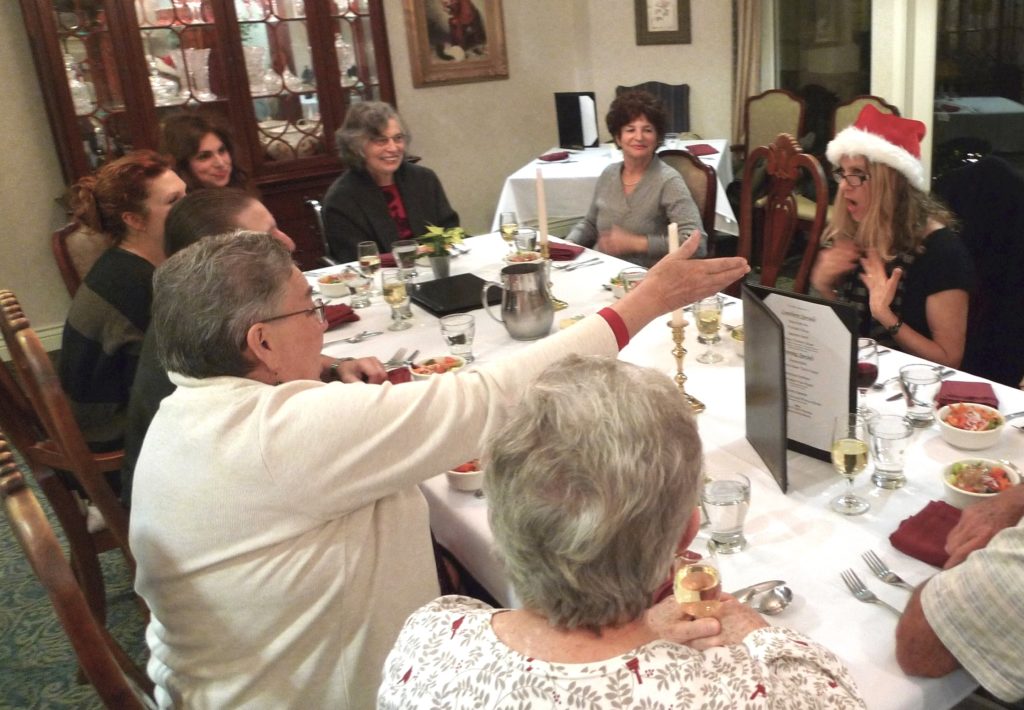
Leslie at the head of the table during a birthday party that Lisa organized for her and local family members. Leslie’s ability to track even a very lively conversations was evident throughout the evening.

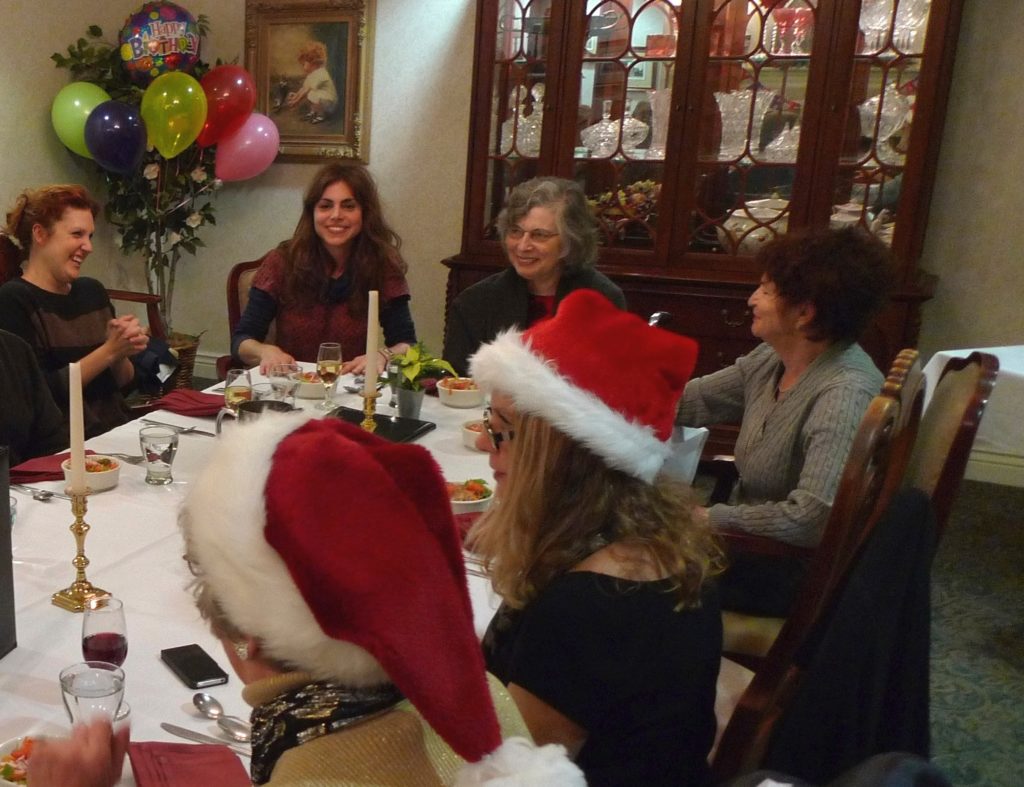
Leslie frequently becomes attentive and engaged if something’s going on among the people she’s with— e.g. having a conversation with each other, trying to solve a problem, telling a story, and so on as during the dinner parties Lisa arranged at Kairos this past year. If we’re walking the halls and we meet someone she knows who says, “Hi, Leslie,” she’ll sometimes say “hi” back. If that person stops and talks with us she’ll track and tune in, and her interest/attention/responsiveness increases if we talk with each other as if she’s part of the conversation. If someone says something to her directly that seems to heighten her engagement and attention (though she might not respond). However, if someone asks her a question with the clear expectation that she come up with an answer, she’s likely to get flustered and withdraw.

Another image from the birthday party Lisa organized for Leslie in the guest dining room at Leslie’s memory care residence.

Leslie spends almost all her days now in a wheel chair. She can still take a few steps unassisted and can use a walker on her own for short distances (across the room, though she is not someone who will “decide” to do that). Usually she is moved by staff in her wheel chair, but some staff also make extra efforts to help her walk around in her apartment, or between the lounge and dining areas (30 feet)—usually with a walker and their assistance. Her walking ability declined quite a bit a year or so ago and dropped a bit more 3-4 months ago, but it’s been pretty stable since, and in the last month or so has actually picked up a bit.

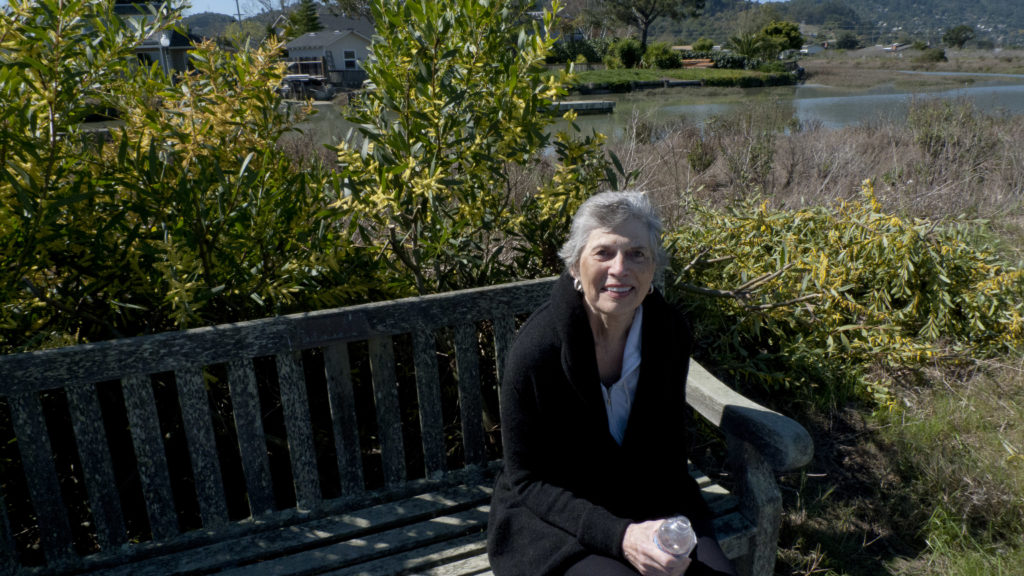
Leslie shortly after she moved into her first memory care residence. When I took the photo, we’d paused for a brief rest after walking a half-mile or so from her home out into the wetlands.

When I “take her for a walk” now, she uses a walker, and she’s also got me on one arm and a care staff member on the other, and we’re pulling the wheelchair behind us. The three of us usually go from her room down the main hall (to the right as you enter the building), turn the corner to the left and go to the door at the end of the hall, then stop, let her sit down in the wheel chair to rest for a few minutes, and then walk back. The total distance we cover is probably 300-400 feet. She does this pretty well some days, and not so well other days. This is a big change from when she first moved into her memory care home and she and I would take a walk together out into the wetlands.

If she’s watching TV when I ask about going for a walk, she’ll almost always say no, so I’ve sort of stopped asking. The phrase I’ve been using that seems to be agreeable to her is, “I thought we’d go for a walk today,” to which she usually says, “Oh, okay.” But sometimes she says, “No, that won’t work,” and I then say, “Oh, it will work. It always works, but we’ll wait for someone to come and help us.”  When I actually start wheeling her away from the TV, I don’t think she’s ever protested.

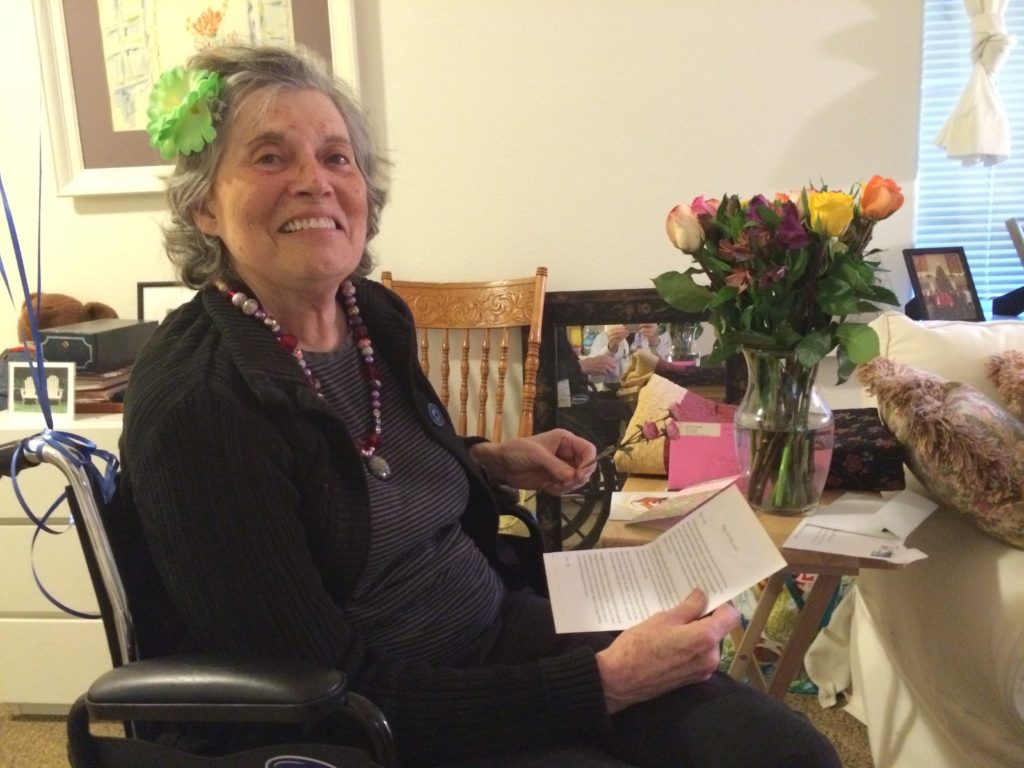
Leslie sitting in her wheelchair in her memory care apartment. During the first 18 months after she moved in, her mobility decreased considerably. I was very dispirited by the decline, but Leslie didn’t seem too troubled. When she could walk, we did–either independently or with a walker. As I learned from Lisa, when Leslie couldn’t walk, she also enjoyed going for a stroll in her wheel chair.

If she is sitting in front of a television that’s turned on, Leslie will watch it with interest, pretty much regardless of what’s showing:  I Love Lucy reruns, Warriors basketball games, news, old movies, more recent movies. Anything. She does not seem to be zoning out (or nodding off) but rather zoning in. To what? I’m not sure, but it looks like she is “following” the implicit story lines embedded in everything we see on TV or in the movies (e.g. everything we see has been edited to lead the viewer forward, to get us to anticipate what’s coming next, and build what comes next on what came just before). I have no idea what she takes away from this as “content” but she does seem tuned into the process and flow of television and movie programming

A personal “conversation” with me is no match for TV. If Leslie’s watching TV she’ll usually look up when I come into a room and call out her name–or when the care staff call her name–and when I come close to her and sit down she’ll usually smile and maybe laugh a little, then shift her attention back to watching TV. If I try to talk with her, she might turn and look at me once or twice, but she’ll turn back pretty quickly and tune into whatever’s on the screen. I think she’s aware, from time to time, that I’m sitting next to her and that this is a plus for her, but I’m not sure.

A personal conversation with me is no match for music or story performances either. Leslie seems to get just as engaged in the “happy hour” music activities and various story-telling and group “discussions” as she does with television. If I show up and she’s sitting in on an activity of that sort, we’ll have our normal greeting and that’s about that. Once again, I think she’s aware from time to time that I’m there and that this is a plus for her, but I’m a sidelight to the main attraction.

She seems to enjoy going outside–in the courtyard or farther afield. After we walk the halls, I usually wheel her into the courtyard and we sit there for a while (15-30 mins) looking at the fountain and I don’t know what else. Sometimes I’ll tell her a story or two about things going on in my life, or show her some photos—on paper or on my iPhone. Sometimes we just sit. Sometimes someone will come by and talk with us.


After Leslie became too unstable to walk safely away from her memory care home with just my assistance, we walked inside. But we both missed being outside, so I began talking her for at least a brief stroll through this inner courtyard. Over time, the stroll turned into a regular interlude of 10-20 minutes where we sat together, absorbed what the weather had to offer, and enjoyed each other’s company.

The care staff seem to really like Leslie. The people who work with her directly have told me that, and they act that way as well. Her current caregivers approach her without any of the caution they sometimes show towards other residents. Mary-Claude says with great affection, “Ahhh, Leslie is my Lady!”  Care staff who have worked with her in the past but now have other assignments (Amanda and Errol, for example) always greet her warmly when they see her. Not sure if this is the right way to put it, but the care staff who work with her treat her as if she’s a somewhat special resource for them, someone they look forward to helping. It’s as if she’s managing her life with a kind of grace and civility that adds a lot to the care staff and to other residents.

Finding My Way with Leslie

I don’t mean to be too pat about it, but in some sense, the these observations and the three assumptions I noted above are what I have in mind when I go to see Leslie, and pretty much whatever I do with her follows from that. They’ve also become the only kind of “answers” I have to all the questions I started with.

As I noted above, most of my initial questions don’t quite make sense to me any more, but they’re questions I’m always asked by other people if they know I’m seeing Leslie. As a result, I almost always fall short of providing good answers. When Lynne asks me, “How was Leslie?” I really don’t know what to say other than, “We had a pretty good visit today,” or “Okay. Her knee was bothering her a bit, so we didn’t walk as far,” or “When I got there they already had moved her to the happy hour music place, so I just stayed with her there for the show” (which is what happened on St. Patrick’s day). So I don’t really know “how” Leslie is in some broad, qualitative sense of “good” or “bad.” I just know what she and I did the last time I saw her and the time before that and whether it was a good visit for me or not.

This is not to say I’ve run out of questions about Leslie and what’s going on with her. It’s just the those questions now focus mzinly on what’s up the day I get there and how I can respond to that in a way that will be okay for me and for her.  Maybe that’s because she seems relatively stable and in relatively good spirits.

I do wonder pretty much every day I visit what we’ll do today. And I hope the logistics for at least a walk will fall into place after I arrive. Will I be able to get a care staff member to help me walk her down the hall? Can we get going on that after the shift change and before they move her to the Thursday afternoon happy hour/music session (which she seems to enjoy and really don’t like pulling her out of)? And I’ll hope her knee is not bothering her, or, if it is, that we can reduce the discomfort enough for her to walk. But if you pushed me, I’d probably say she seems to be doing very well and that where she is seems like a very good place for her to be. I think that’s how Lynne sees things and I think it’s pretty much how Lisa sees them too.

Actually, one of the ironies I’ve noted is that the Lisa I know now is actually at least as different from the Lisa I knew years ago (as a child and teenager) as the Leslie I know now is from the Leslie I used to know!  Another irony is that here I am writing pages of words to the two of you in hopes of bringing you up to date. But when I first contacted Lisa about seeing Leslie, she gave me pretty much a complete picture in two sentences: “She can’t talk much at all and she can’t do very much either, so if you expect her to entertain you, you’ll probably be disappointed. But she does seem pretty okay living where she is, and if you’d like to visit, I know she’d enjoy seeing you.”

I thought I understood what Lisa said at the time, in January of 2012, but I’m still coming to terms with those two sentences. Every time I’ve seen Leslie so far, I’ve found a way to care about her that’s rewarding to me. But to do so, I have to learn each time a little more about what “doesn’t talk much” and “doesn’t do much” can mean. It also seems like I have to learn something new each time about what the words “expect” and “entertain” mean for me. I didn’t envision having to learn about things like that before I started seeing Leslie. And it’s been challenging at times, but it’s also been quite a gift to visit with her as regularly as I do.

I hope these comments give you some updated insights into Leslie’s circumstances. I know she cares about you both and would like to see you. She doesn’t talk much and she doesn’t do much, but she seems pretty okay with living where she is, and I know she’d enjoy seeing you.

I certainly look forward to seeing you as well!

Jon

Posted in Stories | Leave a comment

Hand Chatting

https://vimeo.com/317755264

When she could still walk and stand, I held my cousin Leslie’s hand to steady and support her. It was also comforting and pleasurable for me, and I think for her, but I never thought about it as more than that.

When Alzheimer’s took away her ability to walk and stand her daughter Lisa and I sometimes held her hand to offer assurance when she seemed anxious or stressed—from being questioned, transferred to or from her wheel chair, or moved into an unfamiliar setting. Holding hands for that also seemed pretty straight forward.

But two years after she’d lost her capacity for speech, standing and walking, Lisa and I realized Leslie wasn’t just holding hands. She was playing, teasing us or showing affec- tion, sympathy and appreciation. Or she was wrestling with something we’d said, trying to remember or explore something, or letting us know she was present and asking us to be too. Our hand-to hand interactions went so far beyond “holding” that we needed a new term. “Hand chatting” seemed about right, so we started calling it that and never looked back.

Posted in Meditations | Leave a comment

Inferring She’s There

I made this video while visiting my cousin Leslie in her first memory care residence. It was a nice day, and we’d spent most of an hour or so in the courtyard, sitting with our backs to several trees and watching shadows of their leaves dance on the grass. We couldn’t see behind us, but the shadows and sounds of the breeze left no doubts the trees were still there. 

The video recorded a sample of those sights and sounds. It also reflects the kind of inferences it takes to stay connected with someone who’s living with Alzheimer’s. Even though Leslie can no longer talk, if I’m attentive enough to her cues, she and I can still communicate and enjoy each other’s company. Our exchanges may be less direct than before, but her expressive behavior leaves me with no doubts she’s still there.

Posted in Meditations | Leave a comment

Mind the Gaps


Every photograph frames a story about people who are no longer present, at least not in the same way. The story involves anyone who made the photograph or is visible in it. Some photographs also suggest absences other than those they technically record.

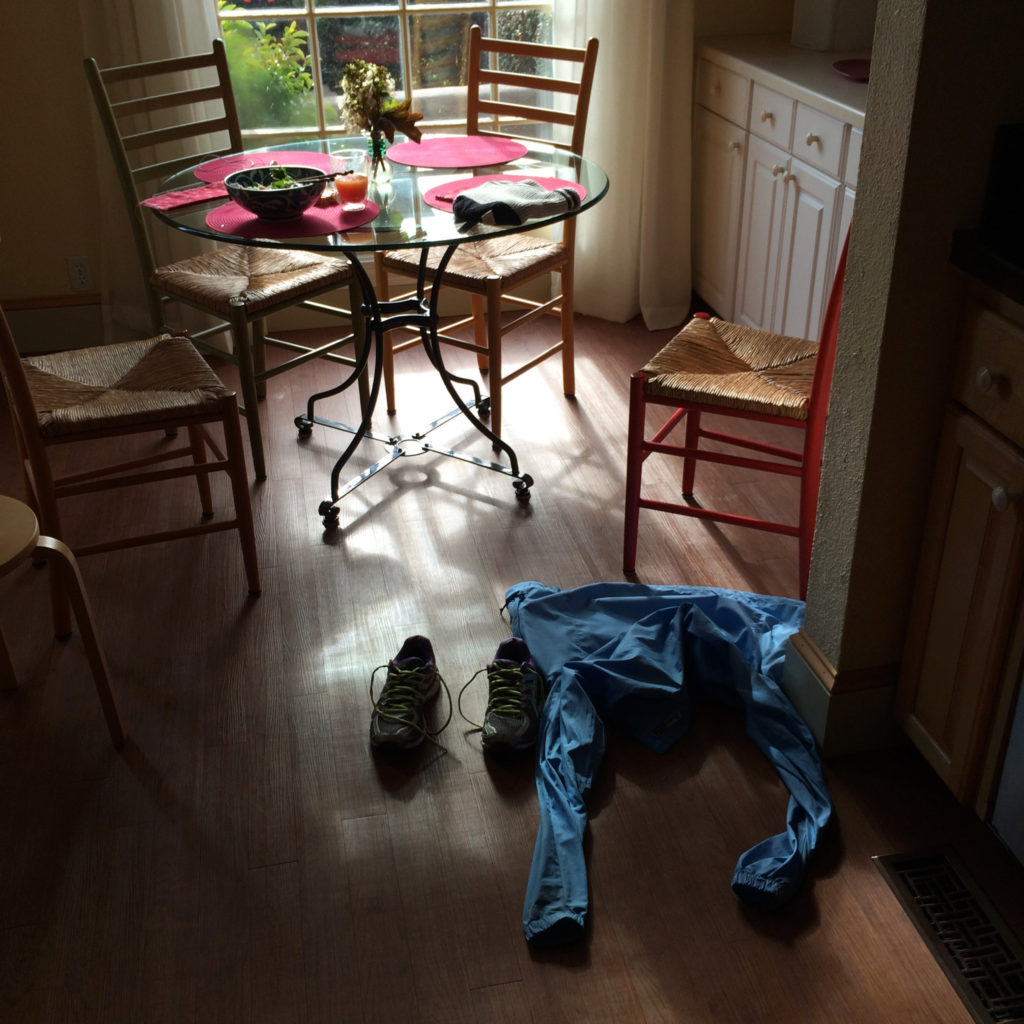
This photo calls to mind a dear friend whose sense of self can shift dramatically from one moment to the next. I took it while the two of us were adjusting to one of those shifts. Neither of us is visible in the photo, but evidence suggests we were both present just before it was taken. In a literal and a figurative sense, we’re not there any more.

I’ve recently been stuck by how personal shifts, absences and forgotten moments build discontinuity into our lives. Take away the props we use to bridge the gaps—calendars, lists, photos, opportunities to talk or text, and so on—and we’d be left with a social amnesia that might look something like Alzheimer’s or dementia. We’d “remember” less, and we’d also be less confident of who we are with each other, and less capable
of acting purposefully.

When I just showed this photo and note to my dear friend, she didn’t remember having ever seen it before (she had). She also didn’t recognize the running gear on the floor as her own, because, as she put it, she never leaves it that way. She doesn’t have Alzheimer’s and is sharp as a tack, but it’s her running gear, so we’re adjusting again.

Posted in Meditations | Leave a comment

Trial and Error

Lisa was a gifted experimenter and my primary trial and error coach. When Leslie became too frustrated to read along with full pages of text, Lisa tried children’s books, photo books and magazines and noted which ones seemed to work better than others. Through trial and error, Lisa confirmed that when her mother pumped her hand up and down she was expressing excitement. Through similar efforts, she became astute in identifying what was likely to comfort or stress her her mom, and she passed tips about that on to other care givers and to Leslie’s doctors.

In addition to physical activities and overall care strategies, trial and error was an essential element of the conversations Lisa and I enjoyed with Leslie. If I saw she wasn’t interested in what I was talking about, I’d switch topics until I found one that caught her attention. If Lisa noticed Leslie’s attention fading while she was reading a magazine with her mom, she might pick up another magazine, or look for something good on TV. When either of us played Leslie music, we’d go through songs and genres until we found one or two that Leslie responded to, then play more of that for a while.

Trial and error approaches were helpful in addressing communication and assessment challenges for both care givers and visitors, and understandably so. Many residents lacked the language or attention skills to clarify for others their interests from one moment to the next–or to negotiate with visitors or care givers about shared activities. Like the rest us, the day-to-day experiences of residents also unfolded dynamically and recursively, with every moment setting terms by which the next could follow more or less agreeably. To work within the flow of a resident’s experiences for a given day, care givers and visitors had to assess where that flow was headed. Trial and error episodes were helpful in doing just that.

These improvised, small scale trial and error assessments reflected few if any standards of formal scientific experimentation. They were extremely valuable, however, in adjusting care strategies to the needs of individual memory care residents. Trial and error cycles were also useful to visitors and residents in negotiating how to spend time together and sustain their relationship from one visit to the next. In some instances, trial and error cycles also provided an existence proof for ideas or care practices that could improve quality of life for people living with Alzheimer’s or dementia. As one example, consider the photographs below.

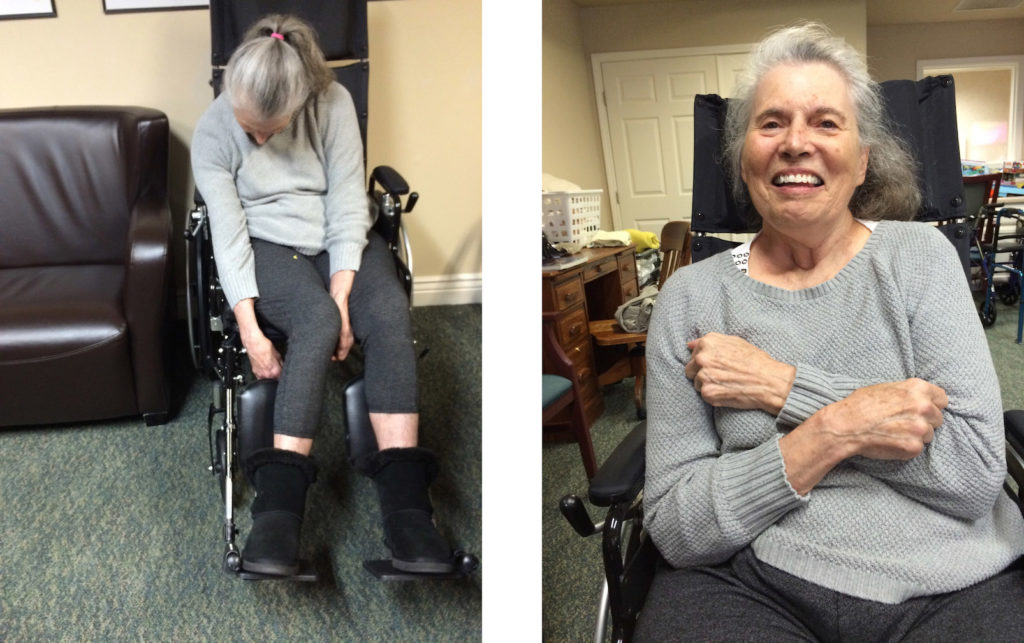
The photo on the left was taken before I coached Leslie through a 40 minute exercise routine; the one on the right was taken after. The routine included range of motion stretches for her feet and ankles, knees and hips, shoulders, elbows and wrists. We also usually did 100 or so repetitions of what I called arm wrestling (where we locked hands and alternately pushed and pulled each other, as in the photos below) and ten or so “push backs” with each leg.

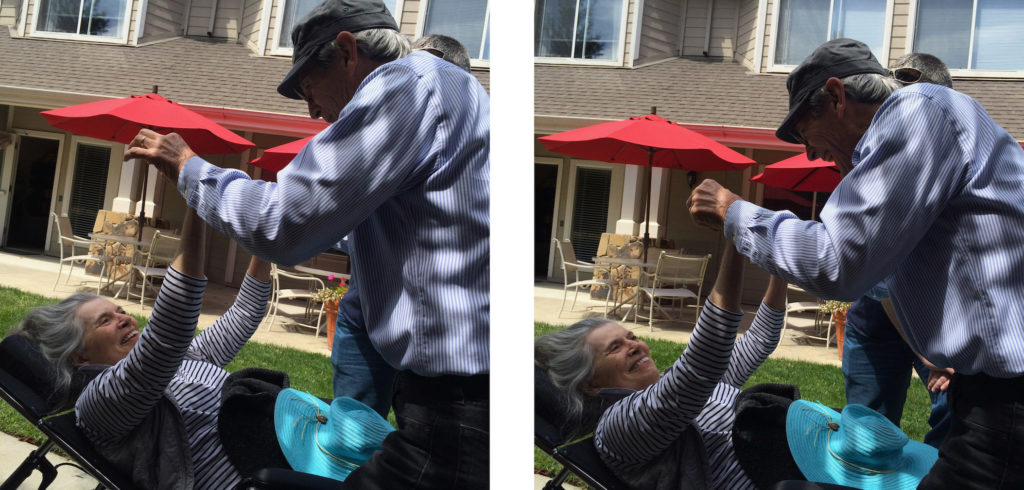
Leslie and I on our way to 100 reps of “arm wrestling” at the end of our regular 40 minute exercise routine. Both Leslie and I enjoyed this kind of back and forth. Helping her through her exercises always gave me a little workout as well.

The exercises Leslie and I did together were pretty straightforward, and we usually had fun doing them. Frequently, however, they also changed how Leslie looked, acted, approached what was going on around her, and interacted with others. Contrasts between the before and after photos not only illustrate some of these changes, they also prove it’s possible for 40 mins of gentle stretching, strength conditioning and massage to transform how at least one person with Alzheimer’s looks, what she expresses, and how she seems to feel.

Proving that possibility might seem trivial within the world of scientific research–and, within that world, it is! But in a world where people can’t imagine anything they could do for a someone living with Alzheimer’s or dementia, it’s a potential game changer. The potential change does not require confirmation by controlled experiments and clinical trials. It’s power rests instead on discomfirming something that at least some people consider to be impossible. A visitor who saw someone looking like Leslie in the first image, for example, might be incapable of imagining the second–let alone what could be done, right on the spot, to facilitate that kind of change. The before and after photos demonstrate that what could not be imagined is, in fact, possible.

Here’s another example where two photographs–one before and one after–document the dramatic change that’s possible for someone with Alzheimer’s or dementia in response to a 40 minute session of stretching, pushing back and massage.

If I had photographed all of Leslie’s exercises sessions, I’d have many, many more of these before and after comparisons, and the majority would document the apparent benefits of her exercise sessions. None of these comparisons would be earth-shattering for someone who already understands that the way people with Alzheimer’s or dementia “look” is as much or more a reflection of their most recent activities and immediate care circumstances as it is of their disease. But few people actually DO understand that in the way these “experiments” document!

The specific “treatments” and “results” documented by this kind of casual trial and error also matter. If more people understood the value of hands-on exercise and massage to the lives people are living with Alzheimer’s and dementia, for example, more visitors might be generating effects similar to those illustrated above. That could be rewarding both to visitors and to memory care residents, who–as a result of getting more “care” sessions of this sort–would look and feel better more often than they currently do without them.

Another similarly powerful “experiment” is documented in this five minute video of Naomi Fell, a skilled care giver and advocate for more interactive approaches to residential care, and Gladys Wilson (who is living with Alzheimer’s). In this case, the “treatment” being assessed through trial and error is face-to-face communication enhanced by questions, kindness and singing:

https://www.youtube.com/watch?v=CrZXz10FcVM

The video records a single interaction between a person living with Alzheimer’s and a care giver. The only element it has in common with formal experimentation is that both the treatment and results are observable and recorded. But depending on where someone is starting from, that can count for a lot. When I first saw this video, it challenged my existing assumptions about which limitations follow directly from living with Alzheimer’s or dementia, and which do not. When I’ve shown the photographs above and this video to others, they’ve been astonished as well. More than one person has remarked, “I had no idea this kind responsiveness was even possible for people living with Alzheimer’s.”

Detailed descriptions of two other trial and error episodes appear in the following posts. In the first, I explore the possibility of stretching and massaging Leslie into a more comfortable position when she was asleep. In the second, I explore how far I could go with her exercises when she was entranced.

Visiting While She’s Asleep (24 April 2017)

Visiting While She’s Entranced (10 May 2017)

For more about “trial and error” in general–and about Lisa’s genius for collaborative care-giving, click this link: Collaborative Trial and Error

.

Posted in Experiments | Comments Off on Trial and Error

Does she still recognize you?

One of the questions Lisa and I were asked most frequently by people who knew her mom had Alzheimer’s, but hadn’t visited, was “Does she still recognize you?” It sounds like a straightforward question, and in some sense, maybe it is. But it’s also been confounding to us, even exasperating or maddening. Not because it’s too personal or open-ended–or because it puts us on the spot to talk about things that we don’t want to talk about–but because it’s not personal or open-ended enough.

Consider some other questions that might be easier, more comfortable or more rewarding to answer about a friend of family member who’s living with Alzheimer’s. “What’s her life like these days?” “What do you do when you visit her?” “What are the ups and downs for her where she’s now living?”

Those are questions we ask about people we’re interested in. They express care and interest in how someone’s life is unfolding, and they include the person we’re asking about among the living. “Does she recognize you?” doesn’t quite do that. It focuses on a single point, beyond which a person with Alzheimer’s can’t do something. In this case, that something is to recognize us, but what does that mean? And what does “still” mean?

Family members and care-givers may identify “turning points” for someone with Alzheimer’s or dementia that follow from the disease itself–like losing the ability to stand or speak–but transitions are rarely either sudden or complete. And other changes follow less from the course of the disease than from treatment and care decisions made primarily by family members and care givers. Beyond their disease and care arrangements, the fabric, rhythm and quality of everyday life for people with Alzheimer’s is shaped by choices they make for themselves: to approach or avoid someone; to do something or nothing with their hands; to open or close their eyes; to listen intently, casually, or not at all; and so on.

The behaviors that people look to as evidence of recognition cut across these different sources of change and variation. As a yes or no question, “Does she still recognize you?” neglects those differences and the contexts and circumstances in which changes may or may not be visible. That’s unfortunate and potentially exasperating, because it’s within those contexts and circumstances–while wrestling with constraints, opportunities and choices of various sorts, moment by moment and day by day–that life can become meaningful for persons with Alzheimer’s or, for that matter, for anyone else.

Specific paths through those contexts and circumstances will vary from one person with Alzheimer’s to another and from one moment to the next–as they do for the rest of us. A favored seat in the dining room may be more important than what’s served for dinner tonight, but not tomorrow night. The darkest despair for one person might come suddenly by learning that a frequent visitor can no longer come; for another it may emerge slowly as a reading becomes more and more difficult, and eventualy impossible. But these differences reflect complexity, not chaos. If we look closely enough at the details of their lives, we’ll see individuals with Alzheimer’s struggling to make the best of what they have, regardless of how little, in our eyes, that seems to be. And some of them will be doing a very good job of that indeed.

It’s difficult to absorb the details and complexity of other people’s lives, but it’s the only way we can fully appreciate their humanity. That’s true whether or not people are living with Alzheimer’s, but those who have the disease deserve that appreciation as much or more than the rest of us. The more important question is not whether they can recognize us the way they used to, but whether we can recognize them they way they are now.

Some additional thoughts about the “Does she still recognize you?” question came to mind when Lisa and I talked through the different kinds of recognition we’ve experienced with Leslie and other residents in her memory care homes. Over time, we pulled these together into the script below. It may be a little challenging to read, but some simple questions deserve a complicating response, and we think that’s true for this one!

*                       *                       *                       *                       *

“Does She Still Recognize You?”

By ‘recognize’ do you mean like to know my name when she hears it and actually say it when we greet each other? Or know I’m the same person each time I see her, from one time to the next? Or know I’m the same as I was 10 or 20 years ago, when I wasn’t very much like I am now, but still had my name? Or do you mean like knowing that I’m the person who has the life I now have, and knowing enough about that so that she can put my life now together with what I was before, like we’d have to do if we hadn’t seen each other for a while? Or are you asking if when we’re holding hands she knows her hand is in mine and mine is in hers, or maybe just knowing it’s the two of us holding hands and not her and someone else?

Or is your question about whether she notices what I’m feeling, or senses that I know what she’s feeling, when we’re together? If so, is that kind of recognition more or less significant than matching names with faces, or matching who I used to be with who I am now? Or are you asking about how confident she is in recognizing me or that I recognize her? Does she confuse me with other people or think I’m confusing her with someone else, is that it? Or maybe it’s do we recognize ourselves with enough confidence to trust each other, or be honest when we’re together? If so, with what margin of error? Do we get a pass sometimes, the way people do when they refer to a brother as an uncle, or a mother as a daughter, and so on, like in Freudian slips? Or when they’re drunk or exhausted? How about when we see someone after they’ve been in the hospital or gone through something physically or emotionally traumatic and we say, they’re “not the person I knew,” even though we call them by the same name? 

Do you mean recognize in that way? Or are you thinking that even though my world and her world have been dramatically transformed over the past six or seven years we might be able to appreciate the changes each other has gone through—even if other people can’t? Is any of this what you mean, or are you asking only about the externals, like seeing people and properly identifying them by accurately matching two kinds of information, like two factor authorization on the Internet? If so. what matches would convince you she recognizes me? My face and name would work for that, right? But what about my face and how it feels to hold my hand? Or the sound of my voice and the regular time I visit? Is any of this what you’re trying to get at? 

Or do you mean recognize more deeply, like when we sometimes hold each other’s gaze, and it feels like we’re seeing each other without much if any artifice, seeing soul to soul and sharing a kind of recognition and intimacy that doesn’t happen often in normal social life, and is pretty disconcerting or even alarming when it does—as it would be if you and I were looking at each other in that completely direct way while I asked you these questions? 

Is that what you mean by recognize, or did you have something else in mind? Like what it would take for you to recognize her–or feel recognized yourself?

Posted in Meditations, Questions | Comments Off on Does she still recognize you?

Seeing a Person Think


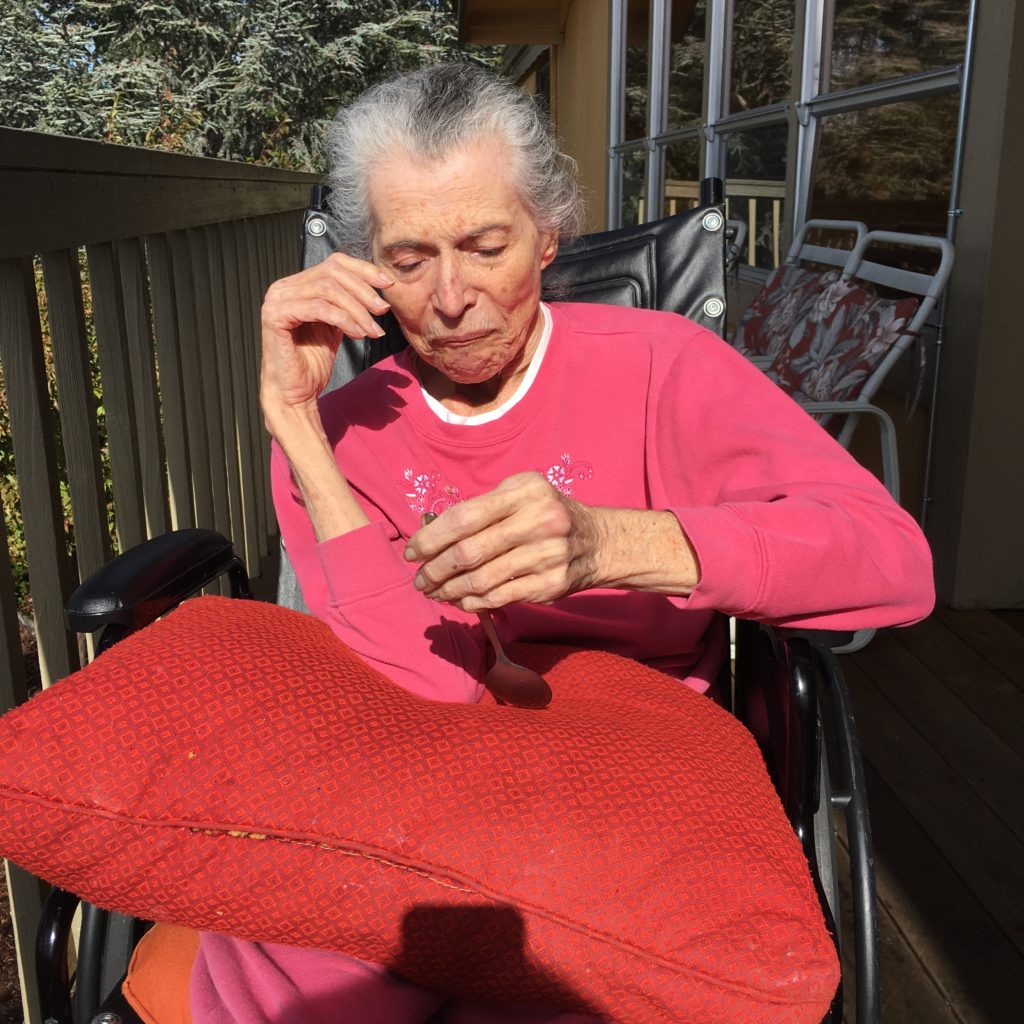
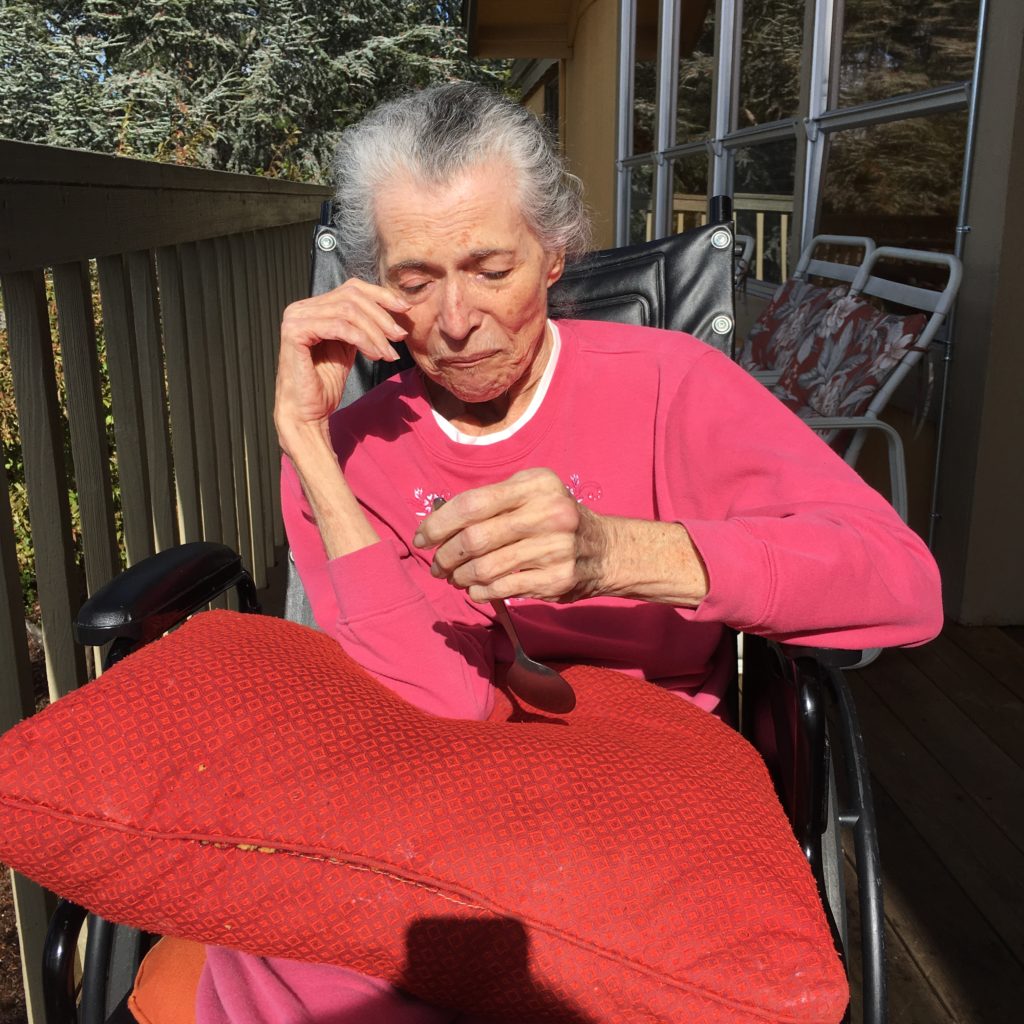
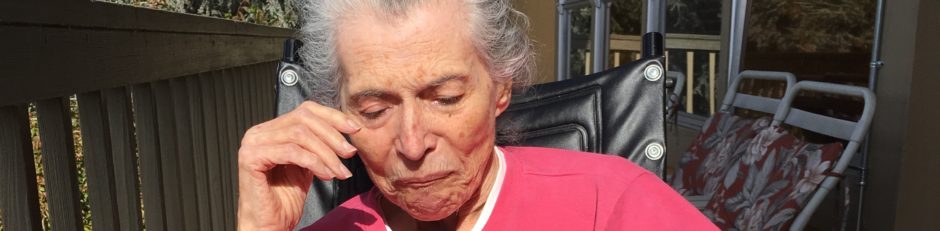
The image above is a slice from one of several photos I took during a visit with Leslie at her memory care facility. I rarely crop photos to remove information about what I’ve photographed, but I had to cut this one down to fit the banner template for this blog. I didn’t worry that the result was an image missing essential information, because it was just for the banner–and that’s a good metaphor for the challenge of understanding Alzheimer’s. For this particular photograph, however, I can restore some of what’s missing by displaying the full frame from which the slice was taken.

The full frame gives a more complete picture of what Leslie is doing–where she’s sitting and on what, her immediate surroundings, what she’s holding in her hand, the weather and so on. It also provides visual information–her facial expression, for example, the direction and intensity of her gaze and the position of her hands–from which we can infer something about what she’s thinking or experiencing.

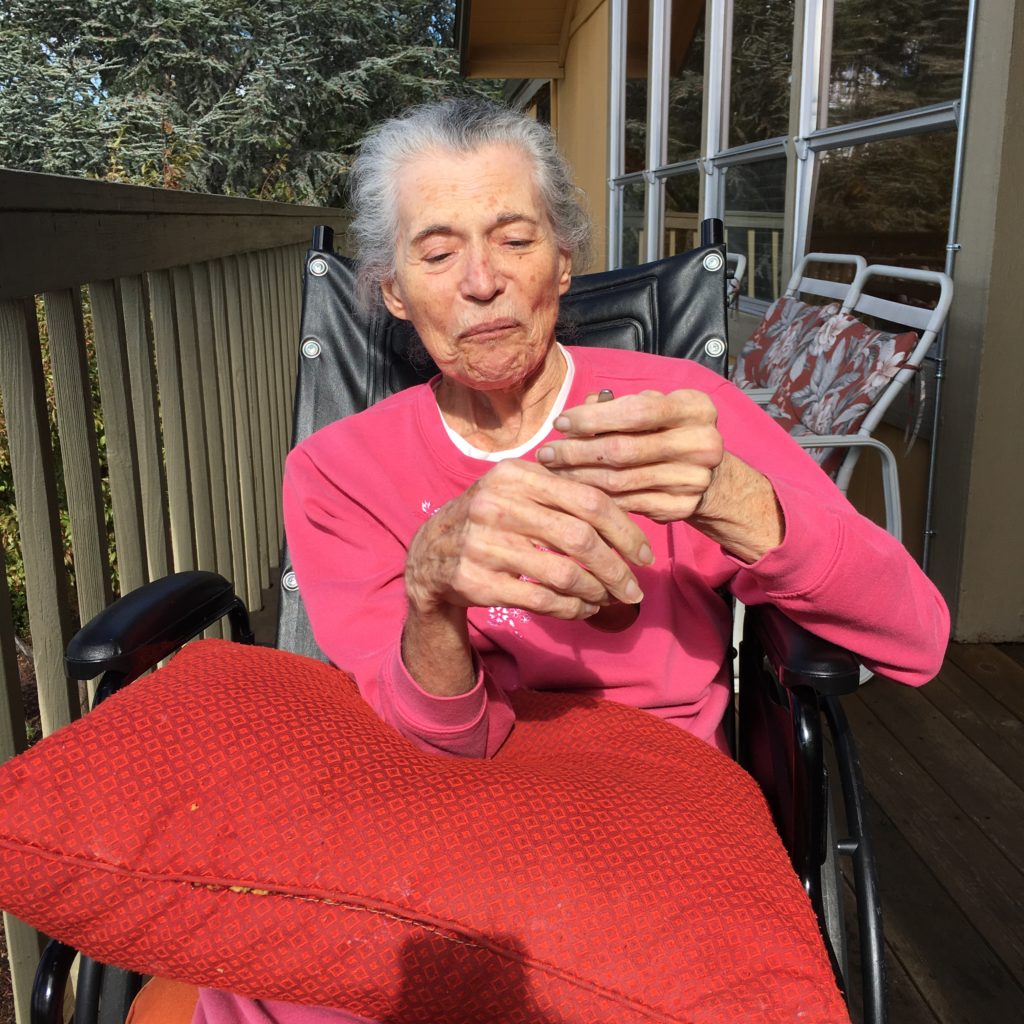
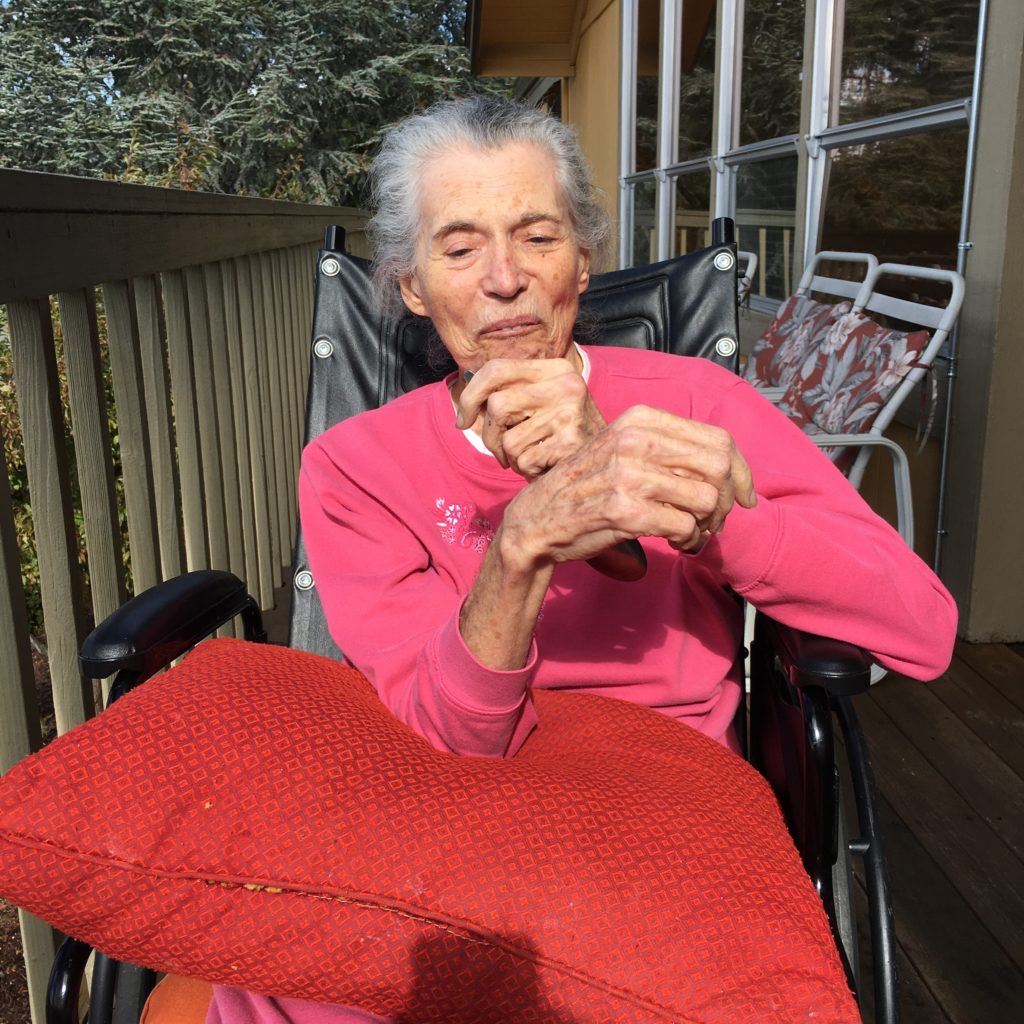
To go beyond how things looked with Leslie in a single instant, other photos taken at about the same time can be useful, particularly if we know the time frame and sequence in which they were made. Consider, for example, the two photos below: the first was taken 10 and the second 5 seconds before the one above.

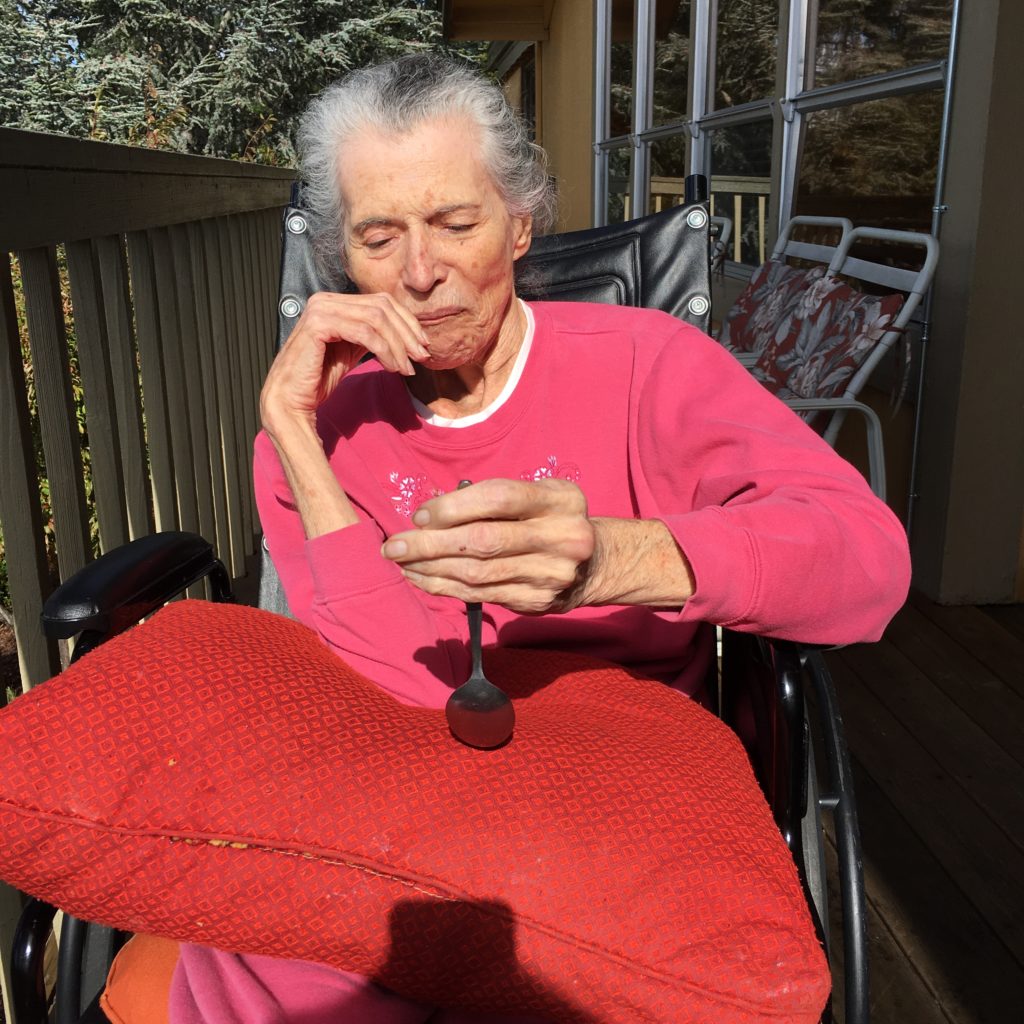
In the timed sequence of three photos we can follow Leslie’s movements and get a better sense of how her visual and tactile attention shifts. We have nothing close to a complete picture, but we can now see enough to surmise that she’s being curious and reflective about something, and that she’s focused her attention on an object that she has the dexterity to display in different ways. Adding two other images to the mix, we get a five-photo sequence of Leslie examining a spoon, or a reflection in the spoon:

The sequence provides even more visual information about what Leslie is doing –and, by inference and interpretation, what she might be thinking and feeling. We can see the positions she moved from and to, not just with her hands, but with her arms, head, mouth and eyes. Above and beyond particulars–the hint of a smile in the first and second frame, the hint of a frown in the last– there’s now information enough to recognize this sequence of movements as evidence of thoughtful activity. That is, going just by what we can see in the photos, Leslie’s behavior looks a lot like what we’d expect from someone who is willfully aware and thinking about what she’s doing.

That’s not to say we can actually tell what’s going on for Leslie during the time these photos were made. We don’t know, for example, if she’s looking at the spoon or at a reflection in the spoon–or, if the latter, what the reflection is of. And we can’t tell what she’s thinking about what she sees. Is the spoon an antique on which she’s trying to read the maker’s mark? Is she assessing whether this is her personal spoon or someone else’s? Is it an unfamiliar object she’s trying to identify or place within the routines of her day?

The photos alone won’t answer any of those questions, but they intimate that something was going on within Leslie’s field of awareness that led her to change the position of the spoon, her head and her eyes. And the way she’s made those changes is consistent with how we think a thinking person looks.

That’s an important contribution of the five photos over the one, for a couple of reasons: First, it gives us at least an inkling of Leslie as a person, as someone who has experience, makes choices and tries to understand what she’s doing while she’s doing it.

For a fuller portrait of Leslie, of course, we’d like to know things that go well beyond how she handled and looked at the spoon and the time during which the photographs were made. How about getting some details and impressions from her of the journey she’s taken into Alzheimer’s, or an account of her transition from one memory care facility to another? Or hearing what she has to say about how her life changed during that journey, what she values now that she didn’t before, or what aggravates her most about her current living situation?

Hearing directly from Leslie about such things could add a lot to what we know about her as a person, but Leslie can’t tell us those things, because five or six years before these photos were taken she stopped talking and writing. That frames a second respect in which the five photo sequence is preferable to a single image: it allows us to “hear” more from Leslie, Stated from her point of view, it expands the depth and scope of her “voice.”

Voice may seem an odd word for describing an exchange with Leslie in which we watch her do something. If we want to understand what she’s thinking or feeling, however, that’s pretty much all we have to work with. Lacking words of her own, she needs something else to express herself. Whatever that might be, it has to fall within what she can manipulate and control. Ideally, it would be a medium or material she’s familiar with and can alter without much effort–and also something we can see, hear or feel.

The micro movements of Leslie’s face, limbs and torso illustrated by the five photographs are a pretty good candidate in that regard. If we follow those movements closely enough, we can get a sense of how she’s responding to something. If it’s to something we’ve said–and the responses are coherent and congruent enough with what we meant–that might suggest her receptive language skills are still somewhat intact. If it’s something we show her or enact through our own gestures and facial expressions, we might feel we’re sharing our experience with her. If we see her respond to something she’s listening to, like a piece of music or the cry of a hawk circling above the deck of her residence care facility, we might get to feel she’s sharing something with us.

——————————————–

Leslie was something of an anomaly among people who live with Alzheimer’s because she lost her expressive language skills early in the game, rather than later. As a result, unassisted two-way verbal conversation with her was a practical impossibility. Leslie was very expressive and responsive, however, and seemed to listen actively and track conversations going on around her. Based on her non-verbal cues and expressions, we felt she understood much of what she heard. The only way we knew that, however, was by attending to how she looked, how she moved, where she directed her gaze, what she touched or reached for or pulled away from, how she sighed or laughed, how she breathed, where she put her hands and when, and whether or how she did any of this while responding to what we said.

To participate with Leslie in this kind of communication, we had to learn how to read subtle variationsin her behavior, but our impression is she tried to meet us halfway. As her expressive verbal language declined, she seemed to hone some existing skills for non-verbal communication as well as develop a few new ones.

Leslie’s ability to communicate through physical gestures and expressions was always in flux, and her repertoire changed over time, both cyclically and in response to her overall decline from advancing Alzheimer’s. As a result, it was difficult to know any of this with certainty. What we did know with certainty, was that she hadn’t so much lost her voice, as changed her medium of expression. Her non-verbal messaging was clear enough for those who cared for her to keep doing so, and to recognize, know and interact with her on interpersonal, or even intimate terms.

If Alzheimer’s had not taken away Leslie’s ability to talk, she could have called people out for behavior she found offensive and offered verbal thanks to others for their kindness. By the time she had moved into her first memory care residence, that was no longer an option. Whenever she was offended or crossed, however, she could still roll her eyes or close them, shake her head from side to side, turn away, display a push-away palm, or cover her face with her hand. When she was appreciative, she could still display a smile that might be faint, mischievous or megawatt. depending on how grateful or sassy she was feeling. She could still reach out and touch someone’s arm or a cheek, or squeeze and shake someone’s hand. She might have lost her ability to speak, but to hear what what she had to say, we needed only to engage with her as fully as we could, and look closely at what she was doing.

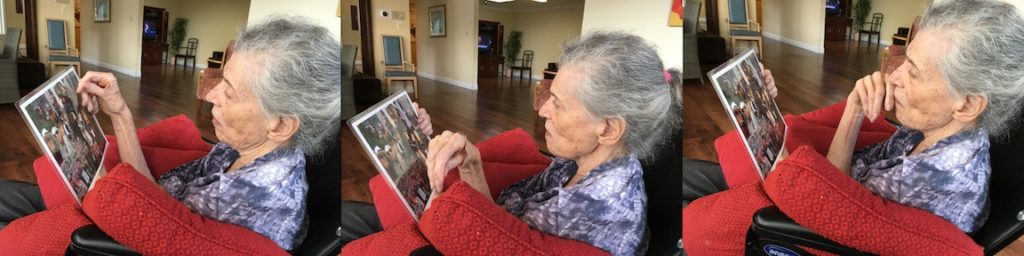
There’s a lot more to be said about communicating with people who are living with Alzheimer’s or dementia, and some of it might be better said with pictures than with words. In each of these two images, Leslie is looking at paper prints of some photographs we took of her and of people she knew and cared about. We can’t tell from these two images what she’s thinking, but we might get some insights into that if we were in the room with her, talking about the photos as she looked at them and looking closely at how she responded to what we said. If Leslie were someone we cared about, or someone we’d like to know better than we do, that might even be kind of fun–for both of us!

For more on using photographs and visual materials to support engaged communication with people with Alzheimer’s or expressive aphasia, see our post on “Alzheimer’s and Visual Literacy” [forthcoming].

Posted in Communication, Strategies | Leave a comment

Amanda Petrusich on Aretha Franklin

In the August 16, 2018 issue of the New Yorker, Amanda Petrusich opened her review and appreciation of Aretha Franklin’s work with the following sentence. I haven’t read anything since that better frames the challenge of thinking one’s self through and past grief–over a death, defeat, loss, or Alzheimer’s diagnosis–and back into the stream of life.

The eternal challenge is to answer grief with something that resembles love. To choose not just to sit around decrying hardship and injustice but instead to uncurl your fists and approach sorrow with grace, power, and, most incredibly, gratitude—not for the hurt itself but for the whole miraculous mess of being alive, this strange endowment of breath and blood.

Amanda Petrusich, “Aretha Franklin is as Immortal as Can Be”

Posted in Meditations | Leave a comment