An Alzheimer’s Playlist: Songs of Loss, Disorientation and Reverence

It’s amazing how many love songs focus on a person who feels unrequited, disoriented, despairing or angry as a result of external circumstances. The circumstances can vary, but their negative consequences for love have brought us musical offerings that lament the end of summer, a new boy or girl in town, the passage of time, lost innocence, the withdrawal of someone else’s affection, the craziness of other people, parental or community disapproval, a violent crime, personal betrayal, illness, a car crash, change in seasons and so, so much more.

Adam Gopnik notes that this pattern–that love promises delight and brightness but is most frequently written about in connection with its absence and associated dark times–has been with us for centuries. And one of Berthold Brecht’s more notable Q&A’s points is at least consistent with that view:

In the dark times
Will there also be singing?
Yes, there will also be singing.
About the dark times.

But if Gopnik is right about love songs, and Brecht is right about the singing, to what can we attribute the absence if songs about the losses people are experiencing day by day–and every day–from Alzheimer’s and dementia? And why, in some sense, are we not surprised about this?

The specter of an ever increasing number people who suffer from these afflictions is certainly a dark time–for them and for those who love and care for them. And before people actually pass away from their effects, these diseases also generate enormous personal losses, including disruptions of loving relationships and, in some cases, even the capacity to love.

For other kinds of dark times, music plays a role in how we help each other to grieve, appreciate what we’ve lost, and, collectively, find a path forward from personal isolation and despair. It works that way with funerals and memorial services for both common folks and celebrities. Music provides something similar for age cohorts in memorializing lost youth at a particular time in history. Frequently, the times lost are themselves defined by musical history.

Music has also been cited as extraordinary integrative resource for people who have suffered trauma from various kind of catastrophes, including natural disasters, enslavement and wars. Doug Bradly noted something along those lines about music of the Vietnam era, “While many of my brothers suffer mentally from our tours in Vietnam. the music helped us keep some sanity in a place and time that stripped our dignity and our caring for others away.”

It seems to us that we could all use some music to accompany the dark times so many people are going through in dealing with Alzheimer’s and other forms of dementia. But we’ve been looking for that without much success. There’s little written beyond the Simon and Garfunkle track “Old Folks” that specifically references “losing” people to what appears to be Alzheimer’s and dementia. But we haven’t given up hope! And we’re inviting visitors to this website to help us fill in this significant blank. If you have a suggestion and can send us a link, we’ll gladly add it to this area of the Resources section.

HOWEVER . . . We recently realized that a slight shift in emphasis, or alternate word here or there, can turn some regular love songs into plausible candidates for the Alzheimer’s and Dementia playlist we’re seeking. In some songs, for example, switching out “eros” for the Greek notion of “agape” will take us all the way home. With others, we need to swap our image of the antagonist, or external circumstance, that’s standing in the way of love, for the phrase “Alzheimer’s or dementia.” Of course, some love songs are just too hot and sexy to survive this kind of make-over–and why bother when we like them just the way they are! But the lyrics of many others–and of many loving relationships–are ambiguous or caring enough to invite less steamy interpretations.

We’ve listed below a few likely candidates for this kind of shape-shifting, but listening to almost any popular love song with Alzheimer’s and dementia in mind has been something of a revelation. Even songs where vivid details in one stanza or another point towards erotic, romantic love have taken on a somewhat different meaning–as if at times the erotic detail was actually diminishing a more universal message of love and loss, engagement and disruption, connection and disconnection.

Maybe that’s what’s most amazing–not that we lack songs about the love and loss that people suffer through Alzheimer’s or dementia, but that we lack the imagination and presence of mind to hear, within the songs of love and loss we’re already familiar with, the restorative, clarifying and healing potential for other forms of suffering, caring and fulfillment.

==========================================

Candidates for an A&D Playlist

The Flaming Lips: “The Castle

Roy Orbison: “In Dreams

David Bowie: “Dollar Days

Death Cab for Cutie: “Codes and Keys

Laura Marling, “Soothing”

Eva Cassidy: “Time is a Healer

Labi Siffre, “Crying, Laughing, Loving, Lying”

Nick Drake, “Place to Be”

Posted in Essays, Resources | Comments Off on An Alzheimer’s Playlist: Songs of Loss, Disorientation and Reverence

How can anyone work all day around people with Alzheimer’s or dementia?

Are you genuinely curious, or just expressing relief that you don’t have to do this kind of work? If you’re curious, we can tell you what we’ve experienced as volunteer caregivers for friends and family members. We can also describe what we’ve learned from observing and talking with other caregivers who do this kind of work for a living.

Many Alzheimer’s and dementia caregivers, for example, have told us they like working with other people and having some day-to-day variety in what they do. They’d rather work in a memory care home than on an assembly line or at a check-out counter, and they like helping residents more than serving customers. They also like somewhat structured jobs where they get to work with other people. They see memory home care as more social and less isolating, for example, than gardening, house cleaning or private home assistance. The caregivers we’ve talked to also value the visibility of their work to others. They’re delighted when residents and fellow caregivers look forward to seeing them, when they light up at the chance to talk, joke, or do something together. And it’s not just about being appreciated. They also like seeing their work improve the quality of someone else’s life.

This kind of improvement may be more visible when caring for people who live with Alzheimer’s or dementia. They’re not not only struggling with catastrophic personal loss, but doing so in the face of death itself. Under such grim circumstances it’s a wonder so many memory care residents find a way to live with grace, dignity and verve. But caregivers see evidence of that and get to help it happen pretty much every day. That’s probably why many caregivers we’ve talked with refer to residents as courageous and heroic, almost as if they were characters in literature or movies. They’ll tell us how remarkable, spirited and imaginative their residents can be—how they talk like poets and say things that are wise, funny and affecting all at once. Rather than pity the people they’re caring for, they take inspiration from them. As volunteer caregivers, we came to see people living with Alzheimer’s and dementia in similar terms. We found ways to engage with them as friends, companions, partners and soul mates. A single visit might bring moments of fun, sadness, stimulation or frustration that, taken together, were extraordinarily rewarding. 

Many caregivers also see people with Alzheimer’s or other dementias as living through the last, and most challenging, chapter of life’s foretold tale. They feel privileged to accompany residents through the end-of-life transition and to share the intimacy, love and reverence it can engender. When that privilege became ours as well, the wisdom of other caregivers was a constant comfort. Watching caregivers help residents pass with dignity from this world to the next, we also came to admire their courage and compassion. In comforting residents and family members, they affirm memory care homes as somewhat sacred places. They cherish the opportunities such places provide for them to help people live more gracefully with Alzheimer’s or dementia and to learn a little more each day about what it means to be alive—not just for memory care residents, but for the rest of us as well.

If you can imagine at least some of what we’ve seen and heard or learned from caregivers, you’ll have a partial answer to your question. And if you can’t, maybe that’s a good place to start.

Are you asking what it’s like to care for people who live with Alzheimer’s or dementia? Or are you wondering how anyone could enjoy a life that different from your own?

Posted in Communication, Meditations, Strategies | Comments Off on How can anyone work all day around people with Alzheimer’s or dementia?

Seeing Selectively

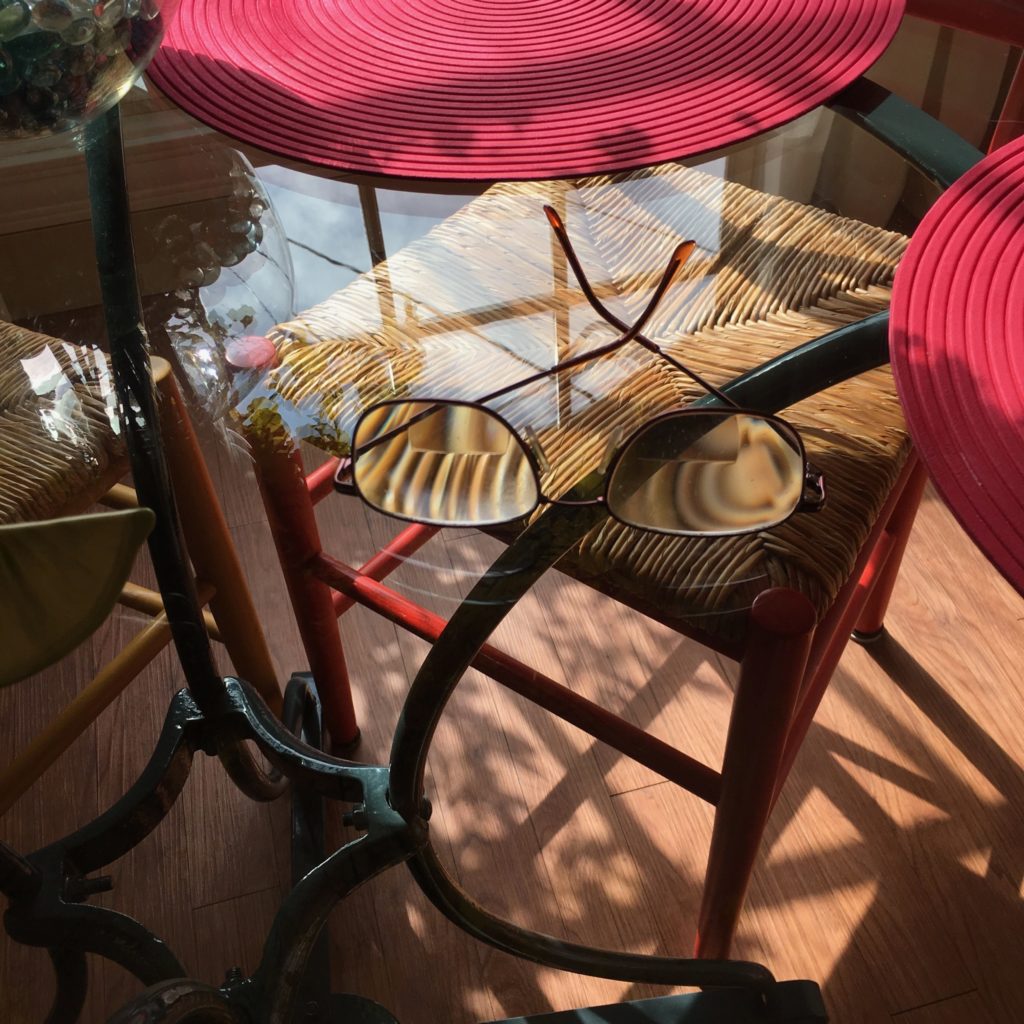
We’ve had this table and these chairs for 20 years or so. I never tire of looking at how they come together from different angles in the changing light from the window behind. 

That appreciation involves both my head and my heart, but it occupies a completely different place in my life than my memories of the countless meals we’ve enjoyed around the table with friends and family members. Those also involve my head and my heart, but the complete separation between these two realms of experience with the same table and chairs is almost easier to explain as a result of my being two different people than anything else. 

As far as I know, I’m not living with Alzheimer’s or dementia. But this capacity to keep looking at the same thing—while seeing it and appreciating it in somewhat different ways—is a little peculiar. It’s all more so when the looking and appreciation occurs while simultaneously forgetting whatever social life I’ve experienced in the same setting.

So, then, where does this kind of attentive and appreciative looking fit with what it means to be alive? When we can no longer move, talk, or claim someone else’s attention, for example, will we still be selecting what we want to look at or avoid seeing? If so, there ought to be room for that somewhere in the art of living.

Posted in Meditations, Uncategorized | Leave a comment

Seeing Continuities

The view from my hospital room the morning after a heart procedure. The version of myself that sees the physical world in terms of light, color, lines, and forms has a lot of vitality, but it’s pretty specialized, somewhat obsessive, and more than a little vacuous. Fortunately, other versions of myself know there’s more to life than forms, angles, the play of light and how things look. These other versions know that being thoughtful and caring towards other people and the world we live in is important, too. But these more thoughtful and caring versions frequently take solace from the patterns and order that the specialized version can see.

This duality is all the more intriguing because my cousin, who has been living with Alzheimer’s for the past eight years or so, seems to have it too. Her life has changed dramatically, and she’s lost the ability to speak and purposefully remember, but her awareness of meaning and feeling for visual forms is still somewhat intact, and similar to mine. 

I’ve noticed this in how she looks at things while I tell her stories. At one moment, for example, she’ll be picking a piece of lint off my shirt or smoothing out the crease in a pillow case. In the next she’ll drop that and turn to look at me with delight as I recount how she taught me to smoke when she was 12 and I was 8. But when that reminds me to mention that her brother-in-law was recently diagnosed with lung cancer, her smile will fade. She’ll lower her eyes, and her gaze will be drawn back to the pillow case. As she smoothes the creases out once again, her fingers are tracing a kind of continuity I hadn’t previously thought to look for.

Posted in Meditations, Uncategorized | Leave a comment

Talking through Loss and Distress – 27 April 2017 –

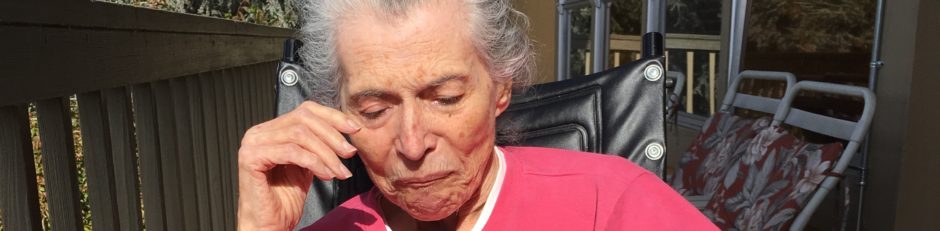
When I arrived at A Kinder Light (Leslie’s second memory care residence) Leslie was seated at Lucy, Vern and Ruth’s table for lunch, facing the window and staring outside. Ruth wasn’t there, but Lucy and Vern were. I checked in with Mercedes and Gina and they said Leslie was doing fine but in one of her “away” modes. I went over, touched her on the shoulder, and sat down next to her, but she continued to stare out the window. When I said “Hello, Leslie. How are you doing today?” she turned slowly to look at me, gave the faintest hint of a smile, and turned back towards the window.

I talked to Leslie a bit while the care staff brought lunch plates out from the kitchen, but she showed no interest in what I was saying or in the food. She just kept staring out the window—intently enough that I got up and looked more closely myself, thinking maybe a deer or another animal had come into view, but I saw nothing more than the parking lot, trees and grass. 

I offered her some water, but she didn’t respond. Same thing when I offered food. I continued talking to her, not rapidly but gently touching on different topics in a conversational tone. Nothing I said over the first ten minutes sparked her interest, so I turned my attention to Vern and Lucy, and talked a bit with them.

While Vern, Lucy and I talked, I continued offering Leslie something to eat and drink, but I didn’t push it for fear that might closer her down even more. About ten minutes into our own conversation,  Alvin, Holly and I said a few things that Gina and Mercedes responded to from a table across the room, and there ensued a brief burst of lively banter and laughter. When I looked back at Leslie after that, she was looking at me and smiling. I said, “Welcome back,” and set about helping her eat again.

Going forward from there Leslie ate and drank a bit, but without showing any appetite or enthusiasm. If my timing was good, I could get several spoonfuls of food in a row into her mouth, and do that relatively smoothly, over the course of few minutes. But if I gave her the next spoon or forkful too quickly, she’d balk, purse her lips and stare me down. 

Leslie had stopped staring out the window by this time, and at moments was a bit more attentive, but she also seemed pre-occupied and troubled. Over the next 10-15 minutes I was able to help her eat and drink a little bit more, but it was very slow going. Every few minutes, Leslie would tip her head down and to the left, hold her face in her hand and prop it up by resting her elbow on the table. Whenever she did, I stopped trying to feed her.

Throughout all this, I continued to talk with Leslie in little bits by making brief comments about topics I thought she might be interested in: updates on Lynne and Joan, news about my brother and sisters, a little something about projects I had underway around the house or anything I’d recently read. But Leslie was unusually unresponsive.

At some point, I just stopped and looked at Leslie sitting there with her head in her hand, eyes shut, and a worried expression on her face. I tried my best to absorb whatever she might be feeling, and something finally clicked—not so much about her as about me. In the blink of an eye, my interest shifted away from trying to draw her out and get her eating and drinking to focus and focused on seeing her and how she was being. My own tension and frustration passed in that moment, and I let out a little sigh.

When I spoke again, a few moments later, the tone of my voice had changed, and so had the pace of my speech. It was as if a somewhat different version of me was addressing a somwhat differen version of her.

“Ahhhh,  Leslie,” I said with affection, before pausing briefly. “It seems to me that you’re struggling. And not only struggling, but also frustrated with your struggles. I have literally no idea what you’re struggling about, and I might never know. I just see that you’re struggling. But I’m thinking maybe you’re frustrated because you’re trying to figure some things out, that are really, really difficult to understand.”

Her head was still tipped sideways and propped up on her hand, but Leslie opened her eyes a little at that and looked at me, so I continued stumbling my way forward though speculations about what might actually be troubling her and projections of what might be troubling me if I were in her shoes.

It was in this somewhat more quiet and less purposeful space between us, and with the tasks of eating and drinking set aside for a moment, that the idea came to mind that Leslie might in some way be facing her own mortality. What struck me was more a shadow of that idea than the idea itself, but it left me wondering: Had she somehow found the time, space, lucidity and courage to sense and accept that she was not only not getting better, but had begun a final descent to the end of her life?

I don’t know why I had that thought, or why I had it right then. Perhaps I was projecting my own fears about that outcome, because Leslie had taken a downturn over the preceding month or so. Perhaps that got me thinking about my own descent and death, and I’d projected that. Or maybe she’d intimated something that I absorbed without noticing, a kind of subliminal message that disappeared before it could be acknowledged.

Whatever the immediate circumstances, my shadow of an idea must also have owed something to the numerous talks Leslie and I had over the years—both before and after she developed Alzheimer’s—about death, dying and experiences of loss. When she was nine years old, she led me (a child of not quite five) through dense brush to the edge of the tall bluffs behind her parent’s home and pointed down to where we could see waves of surf crashing against the dark rocks. “If you fell down there you’d die,” she said. Four or five years later she taught me the lyrics to “If you ever see a hearse go by, and wonder if you were about to die.” Fifty years later we recalled those earlier encounters in a conversation that also touched on the frailty and end of life challenges for our aging parents.

I’d also talked with Leslie after she had developed Alzheimer’s about other experiences of loss: the people we both knew who neither she nor I saw any more; our by then deceased parents, aunts and uncles; and people who were not gone, but difficult to see as often as we’d like. Those conversations frequently seemed cathartic for Leslie, and sometimes for me as well. If I noticed she seemed sad and moist-eyed, I would wonder why, ask her about that, and offer conjectures that she might respond to. Whether the conjectures were right or wrong, may have mattered less than noticing her sadness. As I speculated, and recalled to mind some sadnesses of my own, Leslie’s breathing might slow and deepen until, with a sigh, she’d pull herself up, emotionally, look me straight in the eye, and give me a megawatt smile. I’d take that as a cue to say, “Well, you’re here and I’m here. But who would have figured?” And we’d both get a chuckle out of that.

So, maybe Leslie was facing her own mortality when she was staring out the window and maybe she wasn’t. I didn’t know and she couldn’t tell me. But I could see she was troubled, and I thought she was also frustrated. I couldn’t prove any of this, but it seemed as good a place to engage with her—or even a better—than anything else I’d offered up to that point. Why not have a go by taking deeply troubled, figuring out and frustrated a bit further?

“What I mean by that, Leslie,” I continued,” is that the kinds of questions you are now working on are REALLY big ones—some of the biggest questions anyone has ever asked. They might even be questions that no one has ever been able to answer, and here you are, giving them some considerable attention. At least that’s what I think. I really, truly don’t know what you’re feeling, but this is what I’m thinking.”

Leslie lifted her head up from the palm of her hand somewhere in there. I took that as a sign to continue, and so I did. I didn’t have a script for what I was saying, and wasn’t really looking for one. I just kept looking at her and trying to follow wherever the thread she was responding to seemed to lead.

“You know, you’ve done a lot of figuring things out in your life,” I said. “A lot for yourself, and a lot for other people. I know you had to figure stuff out for your mom, Aunt Kay. That’s a safe bet! And you probably had to help your dad figure some things out as well.”

Leslie smiled a bit at that and sat up straighter.

“I’m sure you also had to figure some things out for Donna and Jim. As their older sister, I’ll bet you FELT you had to figure things out for them, or at least try to! And you probably did, because you’re good at that.  And for your ex as well, at least when you guys were married—or maybe even before.”

I paused for a moment then continued. “I’m just saying you’ve been really good all your life at figuring things out and helping figure things out for other people . . . For me, too! I mean, you told me what high school was going to be like before I got there. And college! And previewing for me lots more like that. And you still are!”

Leslie was now sitting up straight in her chair, holding her head up, looking at me and smiling lightly, the corners of her lips turned down in a little curl of pleasure.

“But here’s the thing,” I continued. “You’re in a situation now where you don’t have to figure everything out. You really don’t. You’ve done this for other people all your life, but it’s now your turn to have other people do this for you.”

Leslie was still smiling, and with anticipation, as I said, “And here’s what I mean by that: Lisa’s caring for you when she’s here and she’s also totally on top of arranging good care for you and making sure everything is working well with that. And I’m caring for you when I’m here, and the staff here are caring for you 24/7. So you actually get to take a break now, because whenever things seem confusing, or changing too fast or whatever, we’re going to try to help you through.”

I leaned back just a bit after voicing the last of of these thoughts, and as I did, Leslie smiled broadly. Compared to how she looked before my unanticipated and unrehearsed commentary, she seemed relieved, more animated and relaxed. I was feeling some relief as well and broke into a smile of my own. 

From that point forward during my visit, Leslie and I played off each other and had a pretty good time together. As she ate the rest of her lunch—with noticeable relish—I switched from the “figuring out mortality” thread to reminiscing about our childhoods. I cleaned up her face, and we rolled back to the activity room to sit for a while, but it was a sunny day, so went from there out onto the deck.

It was breezy on the deck, but we found a sheltered spot that was also sunny where I stretched Leslie’s ankles, knees and legs. I then sat across from her, holding her feet in my hands, and asked her to push them back towards me. She just smiled at first, teasing me by doing nothing. She then settled in and pushed back firmly, and she chuckled when I feigned falling over backwards.

While we were exercising outside, I repeated a few things I’d said at lunch, but in a more lighthearted manner. She was attentive and animated, so I also tried to explore with her what seemed to be a recurring pain along the outside of her left leg.

“Do you still have pain along there?” I asked, rubbing her knee, calf and the “IT” band of tissues and tendons that run down the outside of the thigh. Sometimes this band on Leslie’s left leg was as tight and hard as bone itself. The stretches we did probably helped keep it looser, but from time to time I gently massaged the band directly. I did so with a relatively light touch because Leslie never vocalized or gestured much in response. I wanted to relieve her pain, not add more to the mix, so I was careful to not press too hard, but this time things took a different turn.

As I gently felt the IT tendon and tissues beneath my fingers, Leslie reached over and grabbed my wrist. She pressed my hand firmly against the outside of her thigh six inches or so above the knee, then pushed it up and down along her IT band. I took that as encouragement and applied more concerted force than I had before. I kept my eyes on Leslie’s face, looking for any hint of pain or distress, but all I saw from this more vigorous massage was a beautiful smile, bright eyes and expressions of gratitude and relief.

I told Leslie I was glad the more vigorous IT massage was helping to relieve the pain in her leg, but I was also chagrined I’d exercised with her for over four years before discovering this better approach. As I said that, Leslie reached over with her right hand, grasped my shoulder firmly, and rocked it back and forth slowly while I continued to massage her IT band. We stayed like that for a minute or two while I finished with her leg, then disengaged and just sat there, enjoying the sun for a few minutes.

I left A Kinder Light thinking about the range and depth of Leslie’s feelings I’d witnessed over the course of my hour-and-a-half visit. It was disconcerting at first to see her distressed and troubled, head in her hand and uninterested in eating or conversation. But she didn’t stay in that troubled place, she looked for opportunities to move on, and when she came upon them, she did. That was her process, not mine nor anyone else’s. I was certainly a participant in how we had spent those 90 minutes, but she had found her way into and out of distress while also helping to create—for her and for me—the opportunity we enjoyed later to soak up some sun on the deck and make a nice day of it.

Driving back home I had another thought that was more like the shadow of an idea than the idea itself. This one threw a little darkness around how few choices Leslie has in where she spends her time now and the constant challenge she faces in trying to make the best of wherever someone takes her. Those circumstances and challenges are now radically different from mine, but in time that will change. When it does, I hope I can be as resourceful as Leslie seems to be.
Posted in Communication, Stories | Leave a comment

What can you do if he’s just talking nonsense?

When you say ‘nonsense,’ do you mean vocalizations that are never formed into words, like when we moan or cry out, sigh or smack our lips? Or the fish mouth, cooing and gitchey-gitchey-goo sounds we use with infants and intimate partners? Could he be making word-like sounds in a cadence you both recognize as a sentence in hopes you’ll be playful enough to sentence him back? 

By ‘nonsense,’ do you mean making sounds that aren’t words, like when we moan or cry out, sigh or smack our lips? Or the fish mouth, cooing and gitchey-gitchey-goo sounds we make for infants and intimate partners? If so, is he making those sounds in sentence-like cadences in hopes you’ll be playful enough to sentence him back? Is the rhythm like singing and chanting, or more like how we woof, woof, woof the dog? If  it’s like singing, how about singing along with him? If it’s not, and he’s using words, are they spoken out of order and used in strange ways, with bad grammar—with pauses in the wrong places, or no pauses at all? Is it like poetry in changing familiar, taken-for-granted rhythms and refreshing the language? Does he also use metaphors or invent phrases that sound like what they mean—“smack frittering an egg” instead of scrambling one, or saying  “hold you me” instead of “hold me.” If so, maybe he’s becoming a more poetic soul, and how wonderful that could be for him—and for you! 

Maybe he’s riffing off nursery rhymes or folktales or trying to mimic advertisers or politicians. Could he be mouthing phrases that he knows don’t make sense, just to try them out—things he’s heard from someone else that puzzle him? Is what he’s doing at all like when we repeat memorable lines from movies, plays, or songs that someone wrote just to entertain us? Or like when we make fun of how someone else says something. Could he be doing that with what he’s heard from you?

Or does what you’re calling nonsense come out as intelligible words in well-formed sentences  that are simply not true. Does he say he’s Andrew Jackson’s brother or the first person to cross the Atlantic in a bath tub, or that gravity bends time and space? If so, do you think he might be lying or teasing you? I’m not saying he is, but would his talk still be nonsense if he were? And how does his kind of nonsense compare with saying we feel fine when we don’t—or vice versa? Could he be doing something like that, just to make small talk and stay connected? Or, is he more ambitious than that? When you ask a direct question, does he respond with a story or enigmatic phrase, like Hamlet did, or Jesus or the Buddha? Does he tell you stories that ask too much of you? Are his stories based on what he watched on television the night before? When he talks nonsense, does he assume you remember everything you’ve ever said to him, even little things from several months ago? 

Maybe the best response to any of this are all the little things we do when we can’t understand what someone else is saying: Listen closely. Invite them to say more. Use non-verbal and contextual clues to identify what the person might be responding to. Pay attention to feelings as well as words. You’ve probably done things like that with young children, people who are hard of hearing, or even pets, right? If so, the same skills can help you out here, though they do require patience. Is that an issue as well? Does his talking nonsense make it more difficult for you to be patient with him? Would it be easier for you to visit if he were quiet, or even asleep, than when he tries to express things in ways you cannot yet understand?

Are you asking how you can get him to stop or how to join in? Is your question about getting back to how things were or staying connected?

Posted in Communication, Meditations, Stories | Comments Off on What can you do if he’s just talking nonsense?

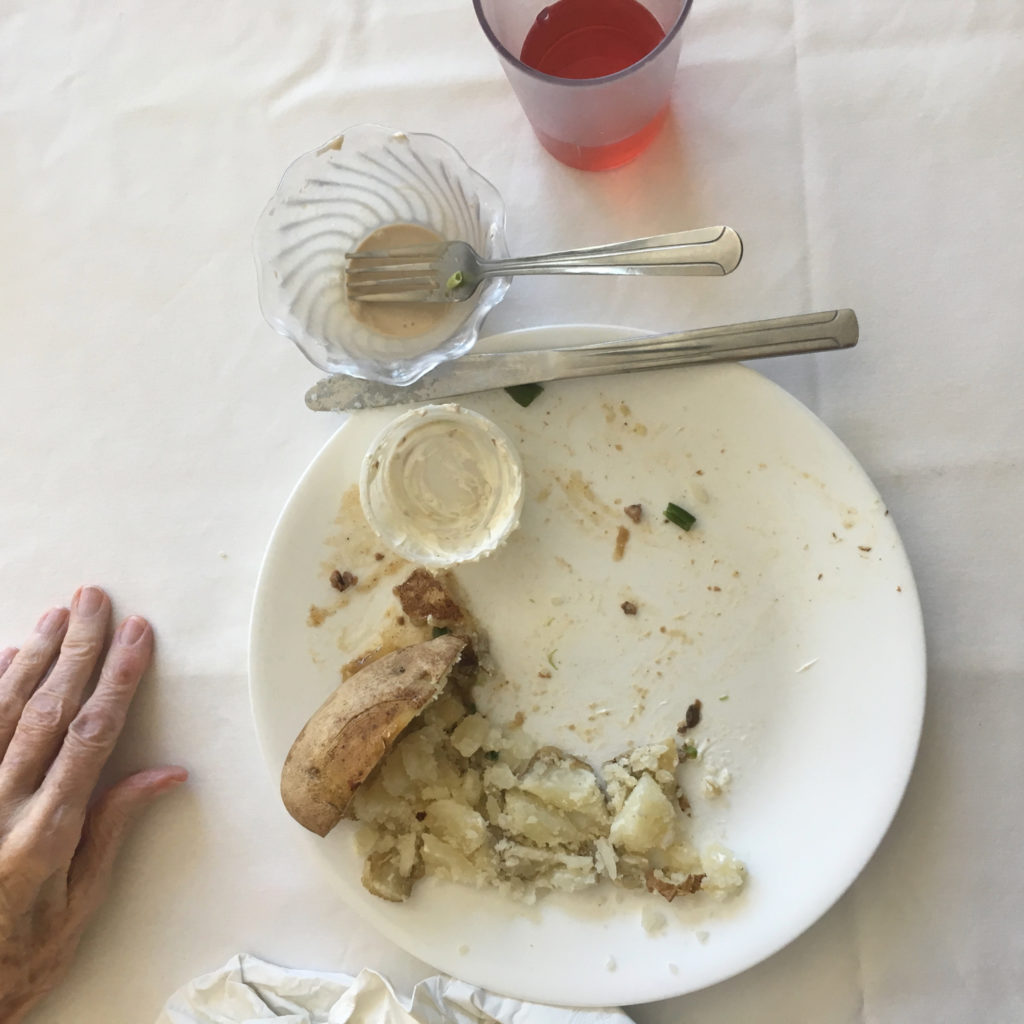
My Cousin Leslie’s Lunch Plate

My Cousin Leslie’s Lunch Plate — Thursday, July 5, 2018

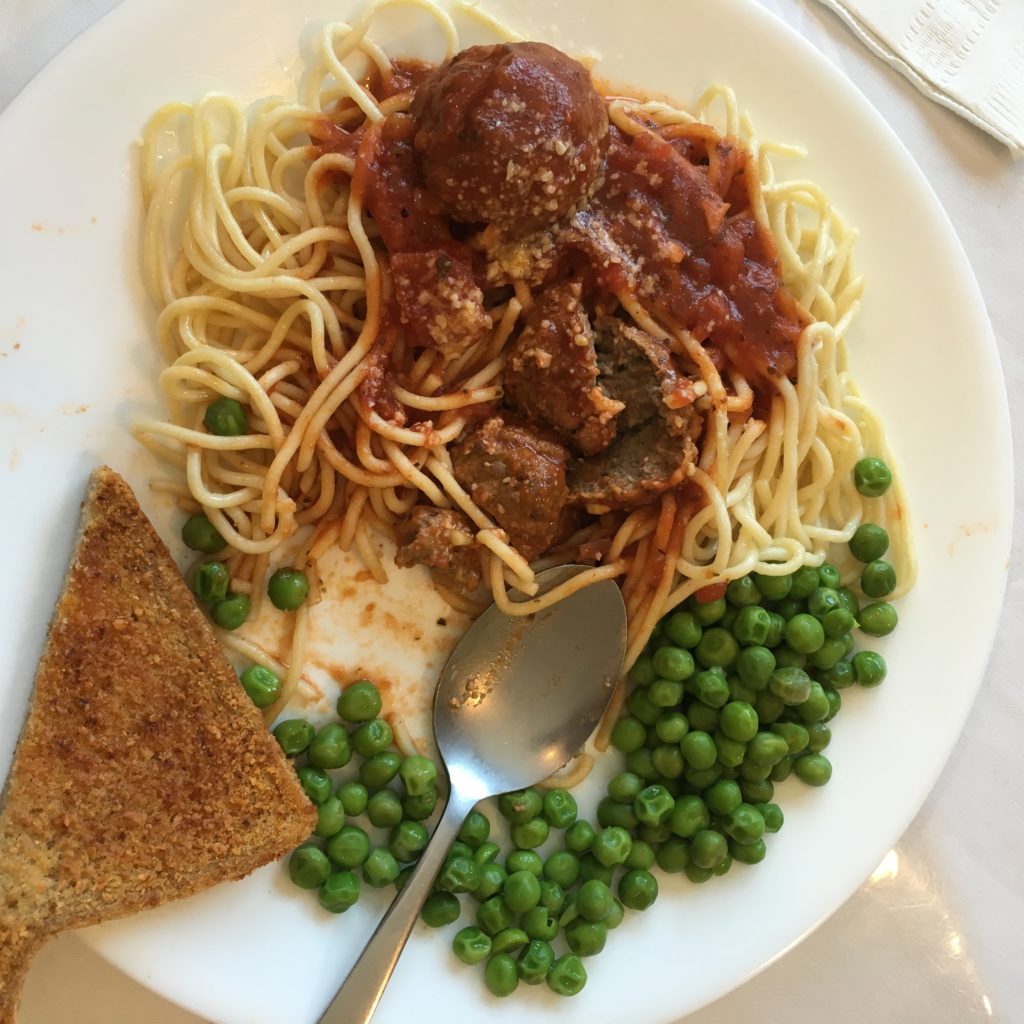
I took this photo of what was left on my cousin Leslie’s lunch plate when I visited with her on Thursday July 5, 2018. If we compared it to a photo of what she was served, we’d have a pretty good idea of what she ate.

But even with two photos, we wouldn’t know whether Leslie fed herself or was fed by someone else, whether her eyes were open or closed while she ate, whether she was entertained by playful banter between care givers and residents or ate alone in the quiet of her room.

The photos alone would not indicate whether Leslie took fifteen minutes or fifty to eat her lunch, or what else she ate earlier or later that day and how that compares to the days before or after. Beyond that, we couldn’t tell from the two photos if she enjoyed her meal, or if she struggled to chew or packed food between her teeth and her cheek.

The questions we can’t answer about my cousin Leslie from a photograph or two of her lunch plate suggest only a few of the many dimensions of her life. But they are hopefully enough to remind us that people with Alzheimer’s not only have a debilitating disease, they also have lives to live—and are doing so, day by day and moment by moment, as are we all.

Posted in Meditations | Leave a comment

Collaborative Trial and Error

As I learned more about the trial and error adjustments she made while visiting Leslie, I came to regard Lisa not only as a kind and loving daughter but also as an extremely imaginative and effective care-giver. That regard persists to this day, but at some point I noticed that her expert care giving frequently benefitted from her mom’s contributions as a “co-experimenter.” It took a while for me to absorb the significance of what I was seeing, but eventually I got it. By engaging her mom in a kind of collaborative trial and error, Lisa and Leslie generated insights, skills and good times together in a way that neither could have done on her own.

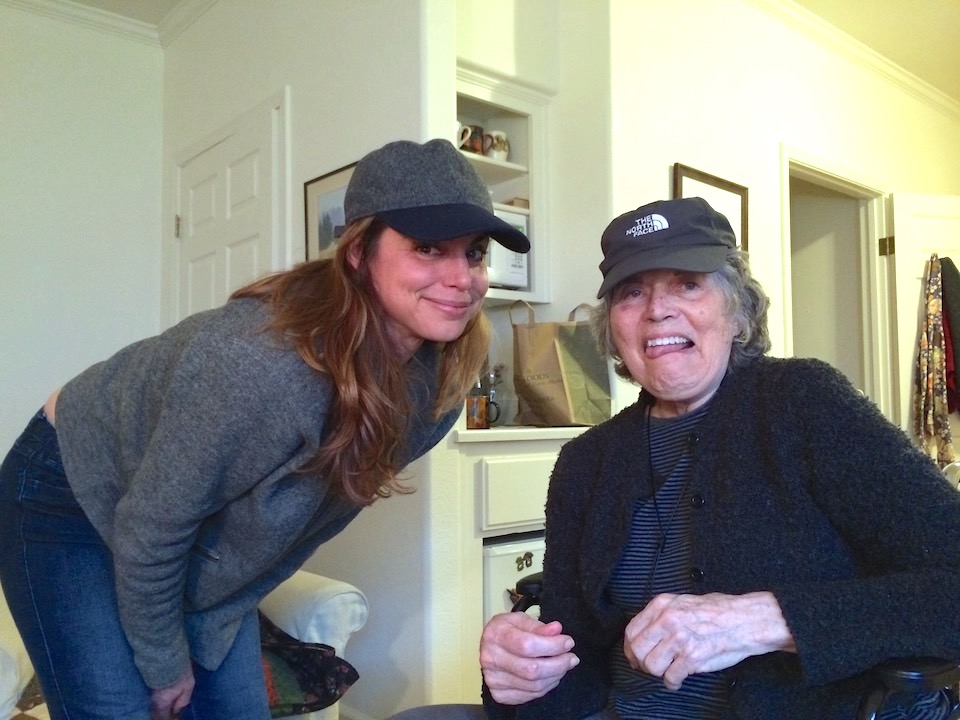
Lisa and Leslie in a playful mood while posing for a photo I took of them wearing hats. The back and forth involved in taking multiple photos to get one that is agreeable to both parties is a good illustration of collaborative trial and error. Lisa was adept at applying the same principle to engage her mom and other memory care residents in a wide range of activities.

What Lisa was doing with Leslie struck me as yet another level of her care-giving expertise, and Leslie’s contributions suggested that at least some of her considerable social skills were surviving the course of her Alzheimer’s. I’d already had that thought about Leslie in light of her responsiveness while interacting with me. But as I learned from Lisa to engage with her mom more collaboratively, Leslie’s ability to reciprocate seemed even more remarkable. Compared to what I’d heard about limitations that plague people living with Alzheimer’s, what I witnessed between Lisa and Leslie seemed at least exceptional, if not unique.

That impression stayed with me for quite awhile, but eventually I noticed Lisa interacting with other memory care residents in the same way she did with Leslie. That fit with my image of Lisa as a expert care-giver. But other memory care residents often responded to Lisa much as Leslie had. What was I to make of that?

My answer came after trying Lisa’s collaborative approach with other residents myself. Lo and behold, I found that most of them had considerable social skills of their own and that some form of collaborative trial and error would frequently bring them into play. As I became more familiar with how resident care givers went about their work, I also noticed that several of them did something similar to what I’d been learning from Lisa and Leslie, and with similar success. I began to realize that Lisa and Leslie were exceptional, but not unique. Some version of what I saw them do together was also possible for other residents and care-givers.

My experience with collaborative trial and error enlarged my understanding of what memory care residents were capable of doing, both individually and collectively. It looked to me as if this kind of exploratory back and forth, for example, could heighten a resident’s sense of agency and stimulate increased interest and sociability. I also noticed that episodes of collaborative trial and error with one resident would sometimes attract others. When care givers welcomed that participation, they were able at times to orchestrate lively rounds of group banter, problem solving or socializing that involved several residents at once–some of whom looked like they were very much enjoying themselves.

Beyond the merits of collaborative trial and error, I took away from what I’d learned from Lisa, Leslie and other residents a sense that HOW people with Alzheimer’s or dementia are engaged by care givers can directly affect the quality of the care they experience. That applies to everything from the quality of their sleep at night, and their interactions with each other, to the food they eat and whether or not they enjoy eating it. Indeed, the dining hall is a prime arena for observing HOW care-givers responsible for feeding and hydrating enlist the participation of residents in eating and drinking. It’s also the setting in which I first noticed Lisa’s ability to engage Leslie in collaborative trial and error.

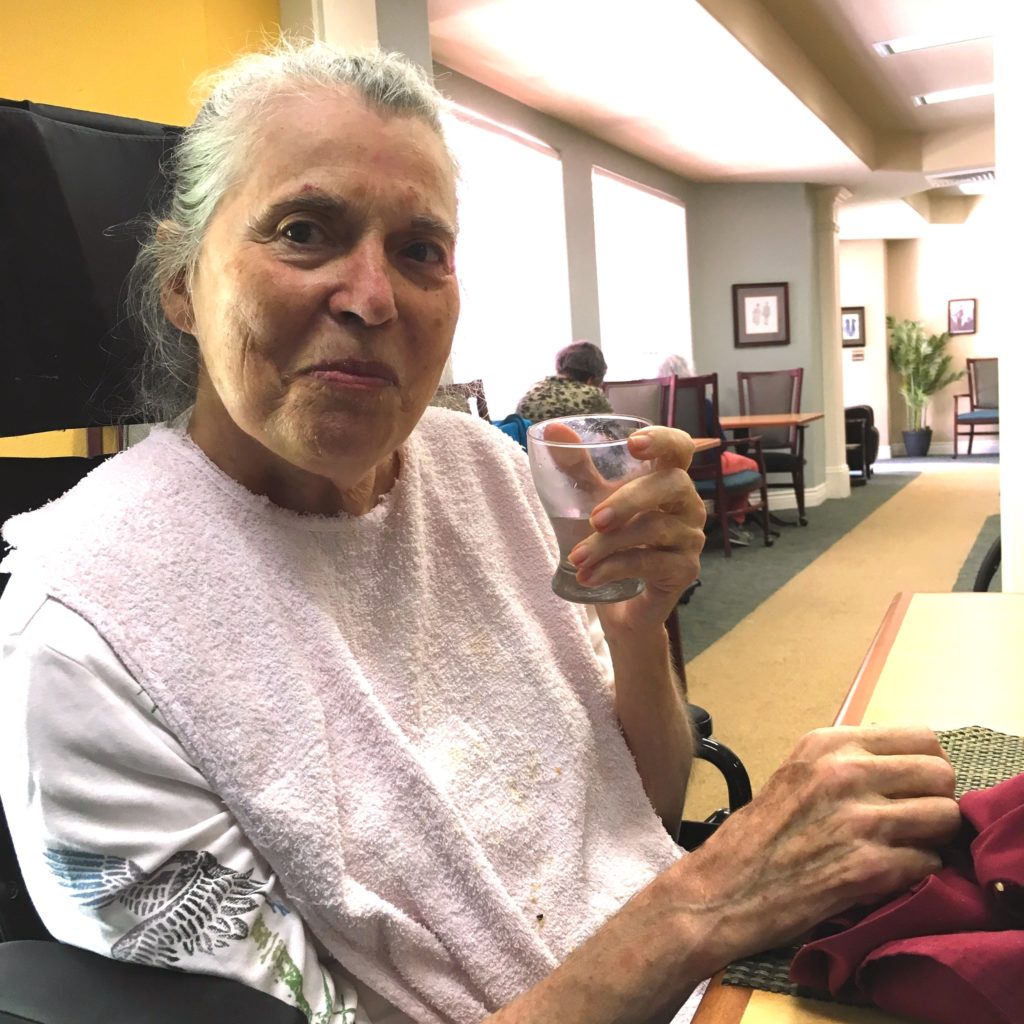
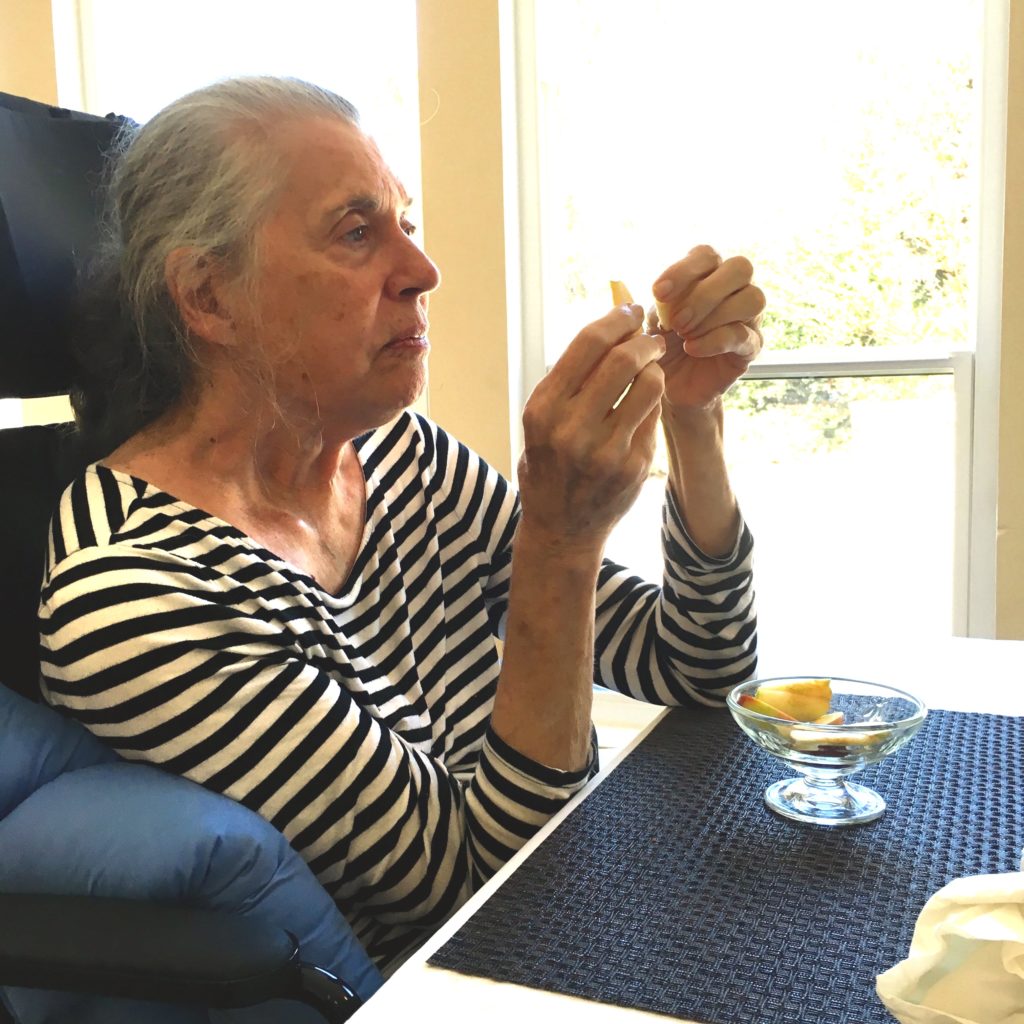
Two photographs of Leslie during phases of her life with Alzheimer’s when she was able to eat with her own hands and drink more or less on her own. Leslie’s ability to feed herself declined slowly overall, but varied year by year and month to month. Sometimes the assistance she needed changed from one meal to the next.

For some care givers, helping a resident eat involved a combination of cajoling and physical assistance. Their collective task was to feed a diverse group of residents in a limited period of time, and most care-givers focused their own efforts on ensuring that each resident would eat well as quickly as possible. Consistent with that focus, most care-givers held themselves at least partially responsible not only for feeding residents–serving food, monitoring consumption, and offering assistance–but also for motivating them to eat. Under these circumstances, the greatest challenge for care-givers was “trying to get everyone to eat.”

Lisa certainly wanted her mom to eat well and experienced some of the same time pressures as resident care givers. As a daughter visiting her mom during mealtime, however, Lisa was much more likely to start from Leslie’s interests than from a priori expectations about how that particular meal should proceed.

“Oh look what we’ve got today,” she might say when a plate of food was put before her mom. “You like some of these things, right? What would you like to start with? Maybe some of these peas? Or maybe. . . All right! You’re already reaching for that chicken leg, so let’s start with that. How about you chew on that a bit and see how it works. If it’s too tough I can cut it up a bit. But here, let me move the plate so you can pick it up and put it down more easily. And let’s see. . . how about we move your juice over here, so it’s out of the way. . .”

And then, as Lisa reaches for the juice and Leslie gently grabs at her wrist: “Oh, I’m being a little too quick with that, I see! So, maybe you’d like a drink first? That’s fine. Here, I’ll help you hold that so you don’t spill. That’s good. Great! Okay, now maybe I can put the juice over here and you can get back to the chicken leg.”

In exchanges like these, Lisa not only exercised the kind of trial and error necessary to assess her mom’s interests and abilities, moment by moment, she also assisted Leslie in conducting trial and error practices of her own.

Every meal required trial and error efforts by Leslie and her care-givers to identify the best way for her to eat each of the different foods on her plate. For this lunchtime meal, she fed herself the toast and most of the peas–the two items easiest to eat by hand and without utensils. I used a spoon to help feed her some of the peas and the spaghetti, sauce and meatballs. On some days she welcomed this kind of assistance, but on others she tried to eat everything herself–sometimes with her hands, and sometimes with utensils.

Lisa’s cell phone also figured in some trial and error explorations with Leslie. When most visitors used a cell phone or iPad to show photographs to a resident friend or family member, they tried to control the display of images and the device itself, perhaps out of concern that the resident might get confused or loose interest. Lisa used her phone to show Leslie photos, too. But if Leslie reached for the phone, Lisa frequently gave it to her.

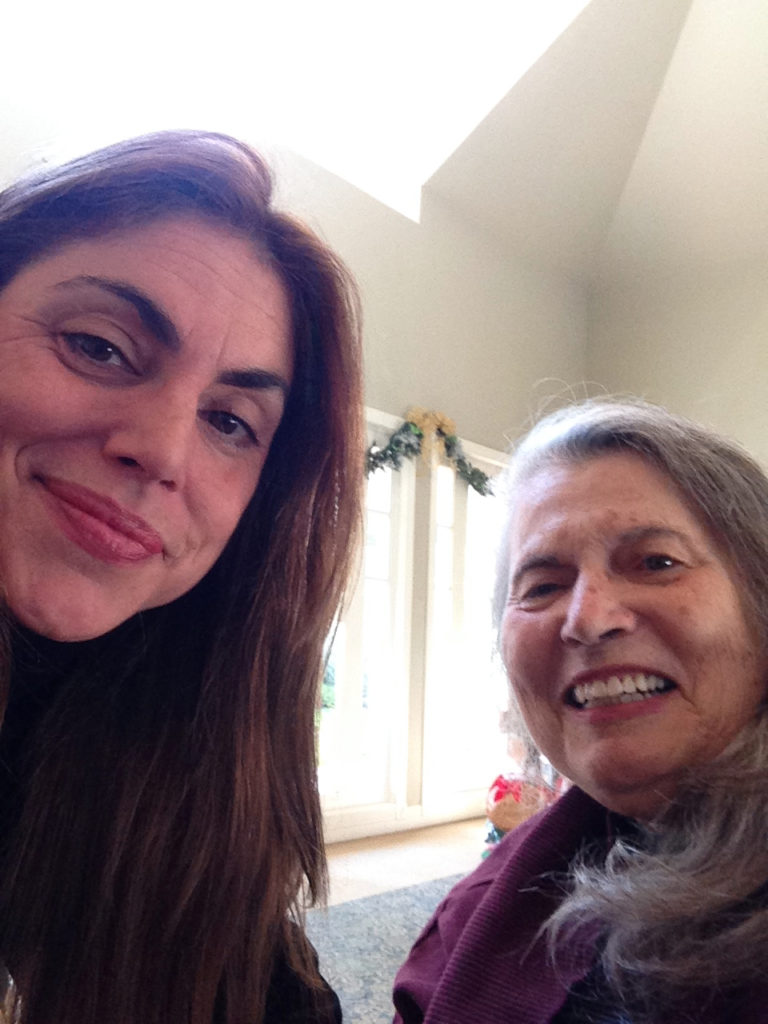
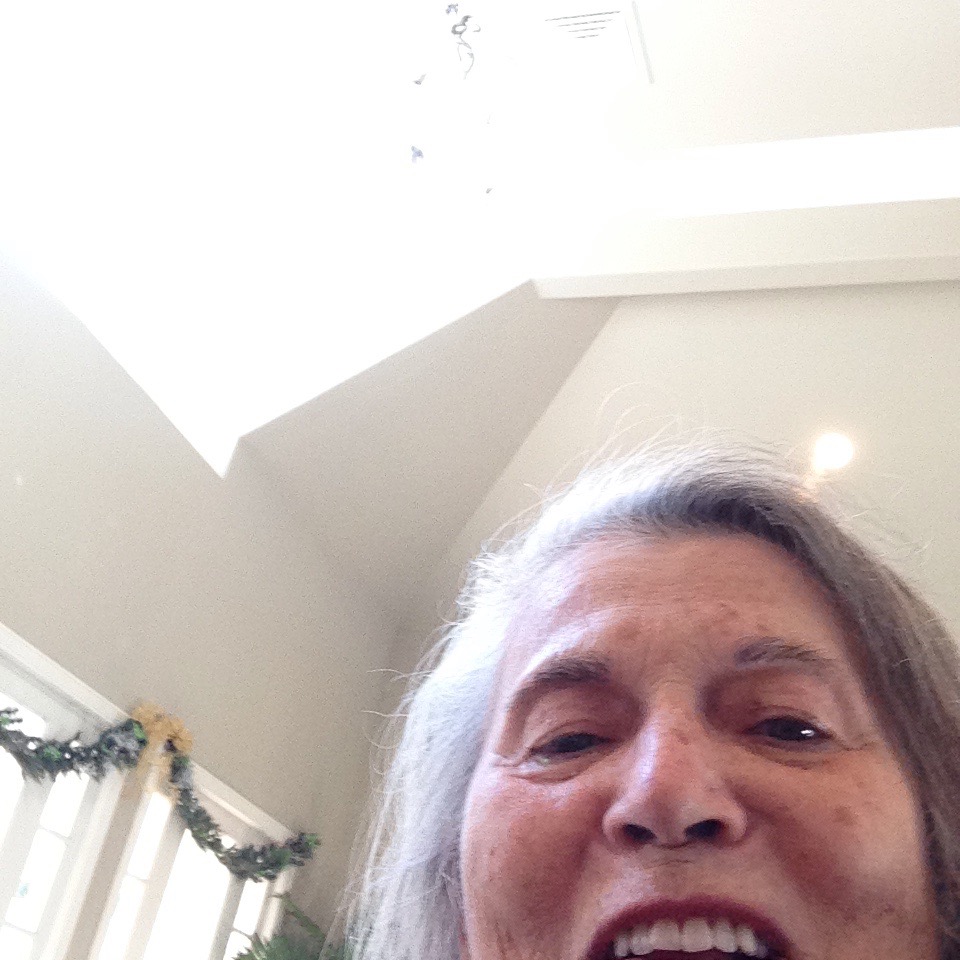
Rather than push her hand away and follow the script of showing Leslie a group of photos, Lisa would change the script. As Leslie played with Lisa’s phone, Lisa would encourage her to try clicking different sections of the screen to see what what happen. Through that kind of trial and error, Leslie learned to use some touch screen gestures that she had not known before developing Alzheimer’s–enough so that the two of them could enjoy taking selfies together.

Two joint selfies that Lisa helped Leslie take of the two of them on her cell phone. For the photo on the left, Lisa held the camera and Leslie pushed the shutter button. For the photo on the right Leslie held the camera and pushed the button.

Once again, Lisa approached Leslie as if they were collaboratively managing the time they spent together. That characterized as well how Lisa and her mom watched television programs and movies, read magazines, and socialized with visitors and other residents.

What was remarkable to me in all of these was not just Leslie’s engagement and focus, but Lisa’s. In some sense, Lisa’s approach started with Leslie’s intentions and disposition at the time, and found ways to align her own interests more or less with those. Once aligned and assisted by Lisa, Leslie was in some sense more able to entertain and care for herself–albeit within Lisa’s presence and circle of attention. The increased agency this opened up for Leslie freed Lisa from trying to “get her mom to do something” and left her more available to simply “be there” and enjoy her company.

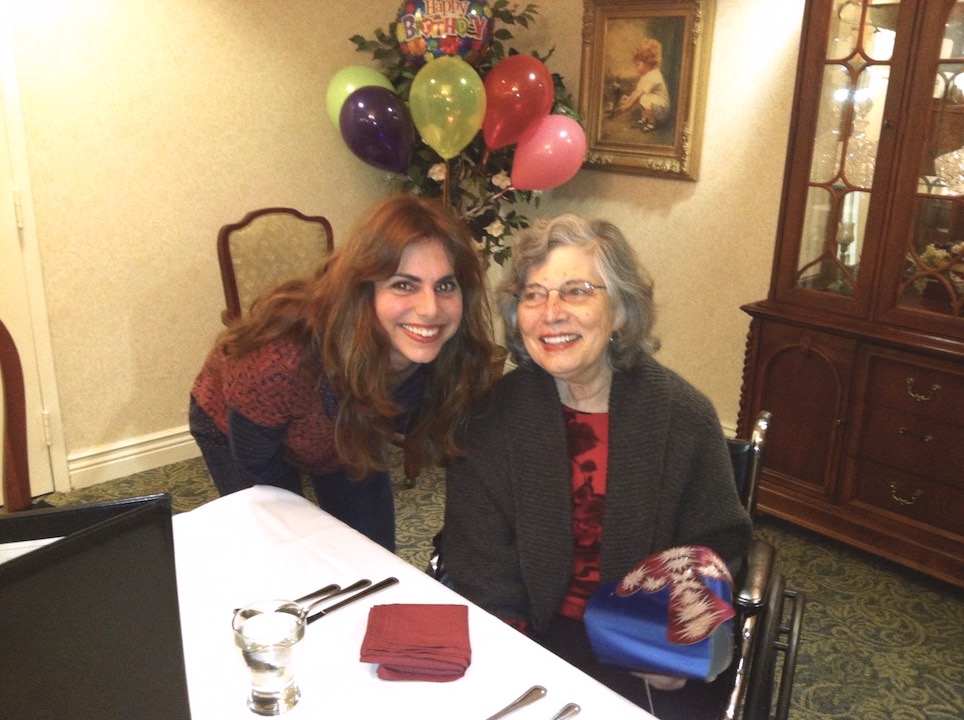
Lisa and Leslie at a birthday part that Lisa hosted for her mom at the end of her first year living in a memory care facility. Lisa did all the legwork for the party, but her mom participated as fully as she could, giving every indication of being fully engaged. Leslie’s expressive language and memory functions were significantly limited by this time, but she was still able and eager to listen attentively. Her gestures and facial expression suggested that she understood the situation and much of what was being said, and her gaze tracked perfectly through two hours of a very lively conversation among the other eight people present.

The outcome of their collaborative trial and error was that Lisa and Leslie spent a great deal of their time together doing things that they both enjoyed: reading magazines, watching movies, listening to music, socializing with care staff and other residents, or even hosting a dinner party. But an essential prelude to whatever “time together” the two of them brought to life was a period of reciprocal back and forth during which Lisa could “be there” for her mom without pushing her to do anything. Lisa understood this process fully and knew that few if any aspects of visiting with her mom could be programmed ahead of time. She might bring some props or materials to share with her mom, but she knew that whether or not that happened would depend on what happened after she got there, between her and her mom, together.

Visitors and care-givers who try to skip the exploratory back and forth necessary to assess and align their own interests with those of a memory care resident are likely to have a much tougher go of it. The equation here is not a zen koan, but it’s close: the path to doing something that’s mutually rewarding to a resident and and care-giver or visitor will take them first through some back and forth moments where they are together and doing nothing.

Posted in Experiments, Strategies | Leave a comment

Empirical Questions

A lot of what we’d like to know about Alzheimer’s and dementia can be asked in the form of empirical questions. By empirical, we mean that the best way to answer the question is to get the best information possible from the most appropriate source.

Here’s an example of an empirical question–the kind of question we can answer if we have enough information of the right kind. If you click on this question, it will take you to an account of one way we have determined what Leslie was thinking and feeling when she could no longer speak.

“If she can’t talk any more, how can you tell what she’s thinking?”

Below are some other empirical questions people have asked us. Over time we’ll try to provide answers to these questions based on what we learned from Leslie, her fellow memory care residents and their care-givers.

  • Do people with Alzheimer’s or dementia still have friendships?
  • Can Alzheimer’s change someone’s personality?
  • How fast does the disease progress?
  • Is Alzheimer’s really a disease or is it just what happens when you get old?
  • What might make it easier for people with Alzheimer’s or dementia to understand?
  • What benefits can come from exercise or physical therapy?
  • What role can music play while visiting someone?
  • What can you do while visiting people when they no longer talk?
  • Is there anything you can do during a visit if she’s asleep?

Just because a question is empirical, that doesn’t mean that we can answer it (or even shed much light on it) from what we learned from Leslie, her care givers and fellow memory care residents. Here are several empirical questions, for example, for which visitors to this site can probably develop answers for the people they are interested in. But answers to these questions will differ from one person to the next because the course of Alzheimer’s or dementia also varies from one person to the next.

  • Should I read her stories, show her photos, make jokes, watch TV, or take her outside?
  • If we walk somewhere, where should we go?
  • What’s the best way to make sure she doesn’t fall or otherwise hurt herself?
  • Would bringing the dog cheer her up?
  • How can I help her keep exercising her mind and memory?
  • What changes would make her living situation more comfortable or engaging?
  • Is she better or worse than the last time I saw her?
  • Is she getting the right medical/health care for her ailments?
  • How can you tell what she’s thinking or feeling?
  • If I visit, how long should I stay?

Even though we don’t have specific answers to these questions, there’s a strategy we can recommend for all of them. The strategy is called “trial and error,” and the posts below describe and illustrate what we mean by that.

Trial and Error

Collaborative Trial and Error

Visiting While She’s Asleep

Visiting While She’s Entranced

Posted in Experiments, Questions | Leave a comment

Problematic Questions

We consider questions “problematic” when they reflect false, misguided or demeaning assumptions. Some problematic questions go beyond that to implicitly or explicitly dehumanize people who are living with Alzheimer’s or dementia, their care-givers, family and friends, or the rest of us. Some questions are also disrespectful to the person asking the question.

By disrespectful, we don’t mean that a question is too candid, probing, or personal. We mean that it denigrates the life and humanity of people, or privileges the experience of one person over another. None of us can always avoid asking questions that include some of these unfortunate features, but we’re trying to reduce that likelihood. For an introduction to our “problematic question” perspective, click the questions immediately below and they will take you to our commentary:

Does she still recognize you?

“What can you do if he’s just talking nonsense?”

“How can anyone work all day around people who have Alzheimer’s or dementia?”

We’ve listed below some other problematic questions that we’ve heard more than once–some of them many times over! We’re developing commentaries for each of these and will provide links to those as soon as they are ready. We’re also preparing a table or “cheat sheet” that pairs the problematic questions below with more constructive questions that might be better to ask out of respect for the people we’re asking or asking about–and to get more useful answers.

  • If someone has Alzheimer’s, there’s nothing you can really do for them, right?
  • Do people with Alzheimer’s even know how bad off they are?
  • Don’t people with Alzheimer’s just want to be left alone? I certainly would!
  • What could people with Alzheimer’s possibly have to live for? 
  • Is her memory gone yet?
  • Does she know where she is and what’s happening to her?
  • Is both her short-term and long-term memory shot?
  • Why visit someone who doesn’t even know you’re there?
  • How could anyone want to live like this? 
  • If you lose your memory and can’t make sense when you talk, what else is there?
  • It’s so depressing to see people like that. How can you keep doing it.
  • Do you ever think, “I ever get Alzheimer’s, I hope someone shoots me?”
Posted in Challenges, Questions | Leave a comment